Winter Heating Tips for Essex County, NJ Homeowners
What Essex County homeowners should know before winter hits — from boiler prep to heating bill savings that actually add up.
Share:
Summary:
Most heating system failures in Essex County happen in February. Not because something broke overnight — because something was already wrong in October and nobody caught it. By the time temperatures drop into the twenties and the system finally gives out, you’re looking at emergency service rates, limited technician availability, and a repair bill that could have been a fraction of the cost if you’d caught it earlier.
This guide isn’t about generic reminders to change your filter. It’s about what actually matters for homeowners in Essex County — and what it costs you to wait.
How to Prepare Your Home for Winter in Essex County
Essex County winters are not mild. January lows in the mid-twenties, heating seasons that stretch from October through April, and a housing stock that skews old — this is not a market where a “good enough” heating system gets you through comfortably.
Homes in Montclair, Bloomfield, South Orange, and Maplewood were largely built before 1960. Many were designed around boiler-and-radiator systems with no ductwork at all. That matters because the standard winterization advice you’ll find online — written for a suburban ranch house with a gas furnace and central air — doesn’t always apply here.
Preparing your home for winter in Essex County means understanding what type of system you have, what it needs before the season starts, and where your home is losing heat before it even reaches the rooms you’re trying to warm.
What Boiler Households in Montclair and Bloomfield Need to Do Before Winter
If you live in a pre-war home in Montclair, Bloomfield, or South Orange, there’s a good chance you’re heating with a steam or hot water boiler — not a furnace. That distinction matters more than most people realize, because boiler prep looks completely different from furnace prep.
For steam boilers, the biggest issue heading into winter is water level and pressure. Your boiler’s pressure gauge should read between 12 and 15 PSI when the system is cold, rising to 15–20 PSI under normal operating conditions. If you’re seeing numbers outside that range, or if your radiators are clanging, hissing, or heating unevenly, those are signs the system needs attention before temperatures drop — not after.
Steam boilers also rely on properly functioning steam vents on each radiator. If a vent is stuck open or stuck closed, that radiator won’t heat right, and the boiler has to work harder to compensate.
For hot water boilers, bleeding the radiators before the season starts is one of the most effective things you can do yourself. Air trapped in the system prevents hot water from circulating fully, which means some rooms stay cold while the boiler runs at full capacity. It’s a simple process — open the bleed valve on each radiator until water (not air) comes out — and it can make a noticeable difference in how evenly your home heats.
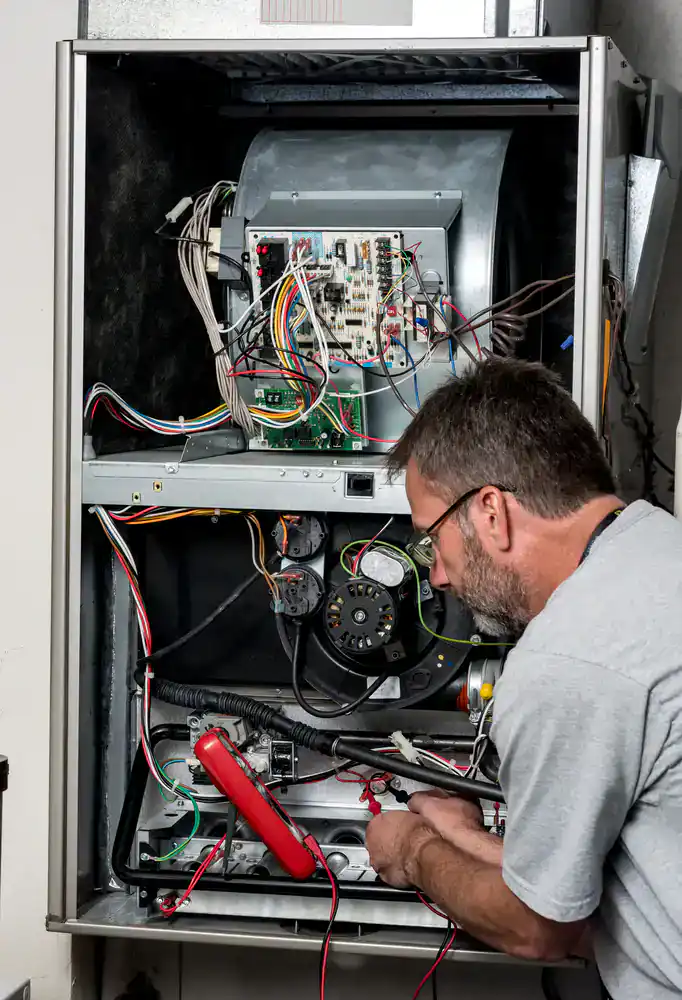
What neither of these systems can tell you on their own is whether the heat exchanger is intact, whether the burner is firing efficiently, or whether there’s sediment buildup reducing the boiler’s output. That’s where a pre-season inspection earns its keep. A furnace tune-up runs $80–$150. The cost of an emergency boiler replacement in January — when demand is highest and scheduling is hardest — is a different conversation entirely.
One more thing worth knowing: if your boiler is running on oil, we don’t repair oil heating systems. What we do is help homeowners evaluate whether conversion to natural gas makes sense — and for many Essex County households still on oil, it does. Natural gas is typically less expensive per unit of heat, and oil price swings tied to global markets add a layer of unpredictability that gas customers don’t deal with. If your oil boiler is aging and you’ve been dreading another winter of delivery scheduling and volatile prices, that conversation is worth having before the season starts.
Where Essex County Homes Lose Heat Before It Reaches the Living Room
Older homes leak. That’s not a criticism — it’s just physics. Homes built in the 1920s, 1940s, and 1950s weren’t sealed to modern standards, and decades of settling, renovation, and wear create gaps that let warm air out and cold air in. In Essex County’s older neighborhoods, this is one of the most common reasons heating bills run higher than they should.
The most impactful places to check are also the least glamorous: the attic floor, the rim joists in the basement, the area around pipes and wires where they pass through exterior walls, and the weatherstripping on doors and windows. For homes in Essex County, attic insulation should fall somewhere between R-38 and R-60 to provide effective winter protection. If you can see the floor joists in your attic, you don’t have enough insulation.
Drafts around windows and doors are easier to address. Weatherstripping and door sweeps are inexpensive and can make a meaningful difference in how hard your heating system has to work. A house that holds heat well puts less strain on the boiler or furnace — which means lower energy bills and less wear on the equipment.
Thermostat habits also matter more than most people account for. Lowering your thermostat by just one degree for a full 24-hour period saves approximately 3% on your energy bill. Setting back 7 to 10 degrees while you’re at work or asleep can add up to real savings over the course of a heating season. A programmable or smart thermostat makes this automatic — and in Essex County, where the heating season runs seven months, the savings compound quickly.
Home Heating Tips That Actually Reduce What You Pay This Winter
There’s a version of this conversation that’s purely about comfort, and there’s a version that’s about money. In Essex County right now, the money version is hard to ignore. NJ Natural Gas customers recently saw a 16% rate increase, and electricity costs across the state have risen sharply over the past several years.
Heating a typical 2,000 square foot home in Essex County with natural gas runs roughly $800 to $1,200 per season under normal conditions. The actions you take — or don’t take — before winter can meaningfully shift where you land in that range.
The tips that actually move the needle aren’t complicated. But they do require doing something before the cold arrives, not after.
How to Lower Your Heating Bill This Winter in NJ
The single most overlooked factor in high heating bills is system efficiency — not the thermostat setting, not the insulation, but how efficiently the equipment itself is converting fuel into heat. A furnace or boiler that hasn’t been serviced in a few years is almost certainly running less efficiently than it was when it was new. Burners get dirty. Heat exchangers accumulate buildup. Ignition components degrade.
The system still runs — it just burns more fuel to produce the same amount of heat, and you pay the difference every month without realizing why.
Upgrading to a high-efficiency furnace rated between 90 and 98% AFUE can cut your heating bill by 20 to 30% per year. On a $1,200 seasonal heating cost, that’s $240 to $360 back in your pocket annually. A mid-efficiency furnace might cost $4,500 installed while a high-efficiency model runs $6,500 — but the $400 in annual savings means the difference pays for itself in about five years, with roughly $6,000 in total savings over the life of the equipment.
What most homeowners don’t know is that NJ Natural Gas offers rebates of up to $1,750 for qualifying high-efficiency boiler or furnace installations. Federal tax credits through the Inflation Reduction Act cover up to 30% of the cost of qualifying heat pump installations. These aren’t obscure programs — but they do require working with a licensed contractor who knows how to document the installation correctly.
NJ requires a minimum 90% AFUE for gas furnace replacements and 82% AFUE for steam boilers under the current NJ Uniform Construction Code. Any contractor quoting you equipment below those thresholds isn’t keeping you in compliance.
Annual maintenance — two visits per year, one before heating season and one before cooling season — runs $150 to $300 in Essex County. That cost is modest compared to what an inefficient system adds to your energy bill over a full winter, and it’s a fraction of what emergency repairs cost when something fails mid-January.
When to Stop Repairing and Start Replacing Your Heating System
This is the question most homeowners avoid because the answer feels expensive. But the math is usually clearer than people expect.
If your furnace or boiler is over 15 years old and you’re calling for repairs with any regularity, you’re likely spending more on keeping it running than you would on a new system — especially once you factor in the energy cost of running aging equipment at reduced efficiency.
A cracked heat exchanger is a specific situation where repair is never the right answer: it’s a carbon monoxide risk, and the only safe resolution is replacement. A pre-season inspection catches this before it becomes a safety emergency. A February breakdown does not.
For homeowners in Essex County who are still heating with oil, the repair-vs.-replace question has an additional layer. We don’t service oil heating systems — not because we can’t, but because the better answer for most oil-heat households is conversion to natural gas. The infrastructure for natural gas is well-established throughout Essex County, and the economics of conversion tend to favor homeowners within a few years of the switch.
If you’re facing a repair bill on an aging oil boiler and you’ve been thinking about converting, that’s the moment to have the conversation — not after you’ve spent money extending the life of a system you’re going to replace anyway.
Financing is available through FTL Finance for homeowners who want to move forward with a replacement or conversion but need to spread the cost. Every estimate we provide is free — no charge to come out, assess the system, and give you a straight answer about what it needs.
Ready to Head Into Winter Without Worrying About Your Heat?
The homes in Essex County are older, the winters are real, and the cost of doing nothing has gone up along with energy prices. A pre-season inspection, a filter check, a conversation about your system’s age and efficiency — none of this is complicated, but all of it is easier to do in October than in January.
We’ve been doing this work in Essex County since 1973. More than 500 homeowners have left us five-star reviews, and we’ve earned them the same way every time — by showing up, giving honest assessments, and not recommending work that isn’t needed.
If you want to know where your heating system actually stands before the cold arrives, reach out to Adriatic Aire. The estimate is free, and the answer won’t cost you anything to hear.
Article details:
- Published by:
- Adriatic Aire LLC
- Published to:
- Last modified:
- October 13, 2026
Share:
Continue learning: