Why Your AC Isn’t Cooling — And What Each Symptom Means
Share:

It’s the middle of July in Essex County. The humidity is thick, the forecast is brutal, and your AC is running — you can hear it — but the house just won’t cool down. You’ve already checked the thermostat. You’re not sure what to do next, and you’re worried that calling someone is going to turn into a conversation about buying a whole new system.
That’s a fair concern. We’ve been diagnosing AC problems across Essex County since 1973, and most of the time, what looks like a major failure has a clear, identifiable cause. Let’s walk through what your system might be telling you.
Why Your AC Is Running But Not Cooling the House
The most frustrating version of this problem is when everything seems to be working — the unit kicks on, air is coming through the vents — but the temperature inside just won’t drop. This is not the same as a system that’s completely dead, and it shouldn’t automatically be treated like one.
A running AC that isn’t cooling is almost always a symptom of something specific: restricted airflow, a refrigerant issue, dirty coils, or a thermostat setting that’s quietly working against you. Each of those causes has its own fingerprint. Knowing which one you’re dealing with changes everything about how you respond to it.
The First Things to Check When Your AC Unit Is Not Cooling
Before anything else, check your air filter. This sounds almost too simple, but a clogged filter is the single most common reason an AC system underperforms, and it’s something you can check in about two minutes. When the filter is packed with dust, pet hair, and debris, it chokes off the airflow your system needs to function. The unit keeps running, but it can’t move enough air across the evaporator coil to actually cool your home.
Filters should be replaced every 30 to 90 days depending on your household — if you have pets or anyone with allergies, lean toward the shorter end.
Next, look at your thermostat settings. Specifically, check whether the fan is set to “on” or “auto.” If it’s set to “on,” the fan runs continuously — even when the system isn’t actively cooling. That means you’ll feel air blowing through the vents, but it won’t be cold air. Switching it to “auto” means the fan only runs during a cooling cycle, which is almost always what you want.
While you’re at it, take a walk outside and look at the condenser unit — that’s the large box sitting outside your home. If it’s surrounded by overgrown shrubs, blocked by debris, or if the fins look visibly clogged with dirt, that’s going to limit the system’s ability to release heat. The condenser needs clear space around it to do its job. Cleaning it or clearing the area around it is something most homeowners can do themselves with a garden hose and a few minutes.
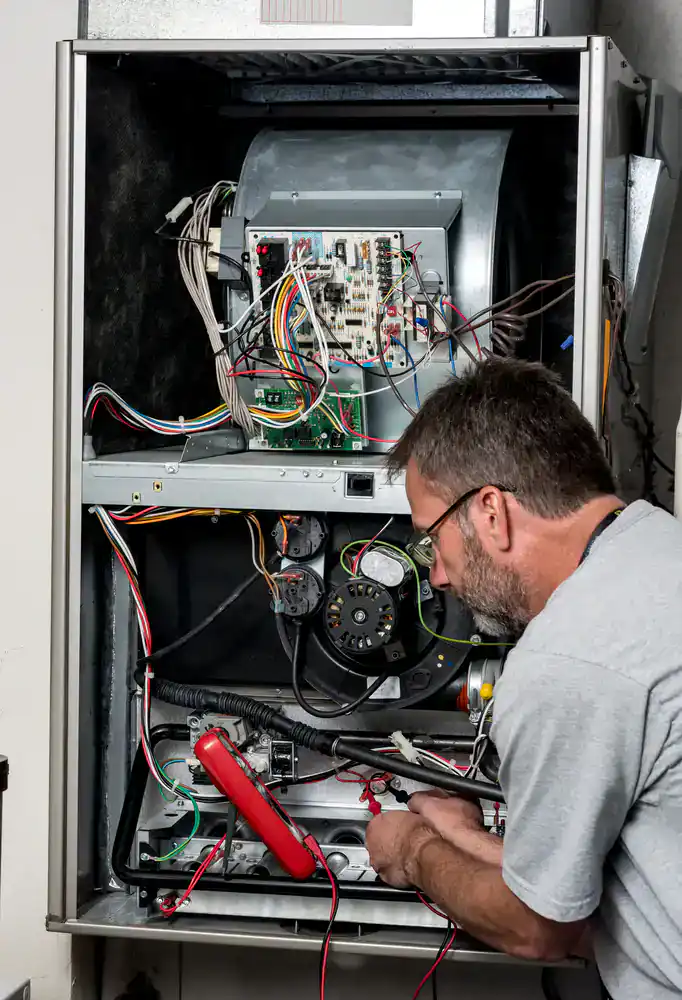
If you’ve checked all three of those things and the house still isn’t cooling, that’s when the issue moves into territory that requires a licensed technician. Refrigerant levels, evaporator coil conditions, and compressor health aren’t things you can assess or address without the right equipment and credentials — and in New Jersey, handling refrigerant without EPA Section 608 certification is illegal.
What a Refrigerant Leak Actually Feels Like in Your Home
Refrigerant leaks are one of the more misunderstood causes of AC underperformance, partly because they’re invisible and partly because the symptoms can look like several other problems. The most common sign is an AC that runs for long stretches but never quite gets the house to the temperature you’ve set. The air coming out of the vents might feel slightly cool — not warm, but not cold enough either. In some cases, you might notice ice forming on the refrigerant lines or on the indoor coil itself, which seems counterintuitive but makes sense once you understand how the system works.
Here’s the thing about refrigerant that most homeowners don’t realize: it doesn’t deplete through normal use. If your system is low on refrigerant, there’s a leak somewhere. Topping it off without finding and fixing that leak is a temporary patch at best. Within a season or two, you’ll be right back in the same situation — or worse, because a compressor that’s been running with insufficient refrigerant is under significant stress.
This is also one of the areas where the “just add refrigerant” approach from less careful contractors can end up costing you more in the long run. A proper repair means finding the leak, fixing it, and then recharging the system to the manufacturer’s specification. That’s the only version of this fix that actually holds.
In older Essex County homes — particularly the Victorian-era and early 20th-century houses you’ll find throughout Montclair, Glen Ridge, and Bloomfield — cooling systems were often added as retrofits to homes that were never designed for them. That means the equipment sometimes wasn’t sized or installed optimally to begin with, which can make refrigerant and coil issues more common over time. If your home falls into that category, it’s worth having a technician who knows the area and the housing stock take a look rather than someone who’s just going to quote you a new system.
When Your AC Won’t Cool Below 75 Degrees
This is a specific and very common situation, and it deserves its own explanation because it’s different from a system that’s completely failing. Your AC is running, it’s cooling to a point — but it won’t get the house below 75 or 76 degrees no matter how low you set the thermostat.
Sometimes this is a sign of a real problem. Sometimes it’s actually the system performing exactly as it was designed to. Understanding which one you’re dealing with matters before you call anyone.
AC Not Cooling Below 75 — Is Your System Actually Broken?
Air conditioning systems are designed to maintain roughly a 20-degree difference between indoor and outdoor temperatures. That’s the engineering reality. So on a day when it’s 96 degrees outside — which is not unusual in Essex County during a July heat wave — your system is doing exactly what it was built to do if it’s holding your home at 76 degrees. It’s not broken. It’s at the edge of its design capacity.
Newark holds New Jersey’s all-time temperature record: 108 degrees Fahrenheit, recorded on July 22, 2011. That’s an extreme case, but it illustrates the point. When outdoor temperatures push past 90, every residential AC system in the county is working harder than it was designed to work under average conditions. Expecting 72 degrees on a day like that isn’t realistic, and a contractor who tells you your system needs to be replaced because it can’t hit 72 in that heat is not giving you an honest diagnosis.
That said, if your system can’t hold 75 on a day when it’s only 85 outside, that’s a different story. The gap between what the system should be able to do and what it’s actually doing is where the real diagnostic work happens. Causes in this scenario often include dirty evaporator or condenser coils, a refrigerant charge that’s slightly low, or ductwork that’s losing conditioned air before it reaches the rooms you’re trying to cool. None of those are automatic replacements — they’re repairs with specific solutions.
Humidity is also a factor that doesn’t get enough attention. New Jersey summers are genuinely humid, and an AC system that’s struggling to dehumidify the air will make a 76-degree house feel warmer than it is. If the air feels heavy or clammy even when the temperature reads reasonably, that’s a separate but related problem worth mentioning when you call.
When “They Said I Need a New System” Deserves a Second Opinion
This comes up more than it should. A homeowner in Essex County calls an HVAC company, someone comes out, takes a look, and within twenty minutes they’re being told the whole system needs to go. Sometimes that’s the right answer. But it’s not always the right answer, and the difference matters — both for your wallet and for your peace of mind.
There’s a well-documented pattern in this industry where a compressor that still has life in it, or a refrigerant issue that’s fully repairable, gets framed as justification for a full replacement. That’s not a diagnosis. That’s a sales pitch. A real diagnostic process involves checking the actual components — refrigerant pressure, coil condition, compressor amperage, airflow measurements — before drawing any conclusions about whether repair or replacement makes more sense.
We’ve been doing this in Essex County since 1973. We’ve seen systems that looked dead on the surface turn out to need a relatively straightforward repair. We’ve also seen systems where replacement genuinely was the right call — and in those cases, we’ll tell you that honestly and explain exactly why. What we won’t do is recommend a new system because it’s easier or more profitable than finding the actual problem.
Our approach has always been to diagnose first and recommend second. That’s not a policy we invented — it’s just how honest HVAC service works. It’s also why we still have customers in Montclair, Bloomfield, and across Essex County who’ve been calling us for decades, and why our reviews consistently mention that we explained everything before doing anything. If you’ve already heard from one contractor that you need a full replacement and it didn’t sit right with you, a second opinion costs you nothing. We offer free estimates on every project, and we’ll give you a straight answer either way.
Getting Your AC Diagnosed the Right Way in Essex County
Most AC problems have a cause. Most causes have a fix. The goal of this page was to give you enough context to understand what your system might be telling you — and to help you walk into that first conversation with a contractor knowing what questions to ask.
If you’ve checked the filter, confirmed the thermostat settings, and the house still isn’t cooling the way it should, that’s the point where a licensed technician needs to take over. Not to sell you something — to find out what’s actually wrong.
Adriatic Aire has been diagnosing and repairing AC systems across Essex County since 1973. If you’re ready for a straight answer, we’re ready to give you one.
Article details:
- Published by:
- Adriatic Aire LLC
- Published to:
- Last modified:
- September 22, 2026
Share:
Continue learning: