Evaporator Coil Replacement Cost in Essex County, NJ: Is It Worth the Repair?
Staring at a repair quote and not sure if it makes sense? Here's what evaporator coil replacement actually costs in Essex County — and how to decide.
Share:
Summary:
You’re not cooling down. The AC is running, the vents are blowing, but the air coming out feels like it forgot its job. A technician comes out, runs a diagnosis, and tells you the evaporator coil is leaking and needs to be replaced. Then comes the number.
Your next move is probably to Google it — and you’ve landed here. Good. Because the national cost guides will give you an average that may have nothing to do with your specific system, your home’s age, or what’s actually happening in the Essex County market right now. Let’s talk through what this repair really involves, what it costs locally, and how to know whether it’s the right call.
AC Coil Replacement Cost: What the Numbers Actually Mean
National sources quote evaporator coil replacement somewhere between $600 and $2,000, with a commonly cited average around $1,350. But out-of-warranty replacements — which is the reality for most homeowners dealing with a system that’s more than a few years old — can run $2,500 to $4,500 or more once you factor in the coil itself, labor, refrigerant, and any ancillary work the job uncovers.
That spread isn’t vague — it’s real. The price depends on your system’s size, the type of coil, where it’s physically located in your home, and what refrigerant your system uses. In Essex County, where labor rates run higher than the national average and older housing stock creates access complications, the lower end of those ranges is rarely where homeowners land.
Indoor AC Coil Replacement Cost: Why Your Home's Setup Changes the Price
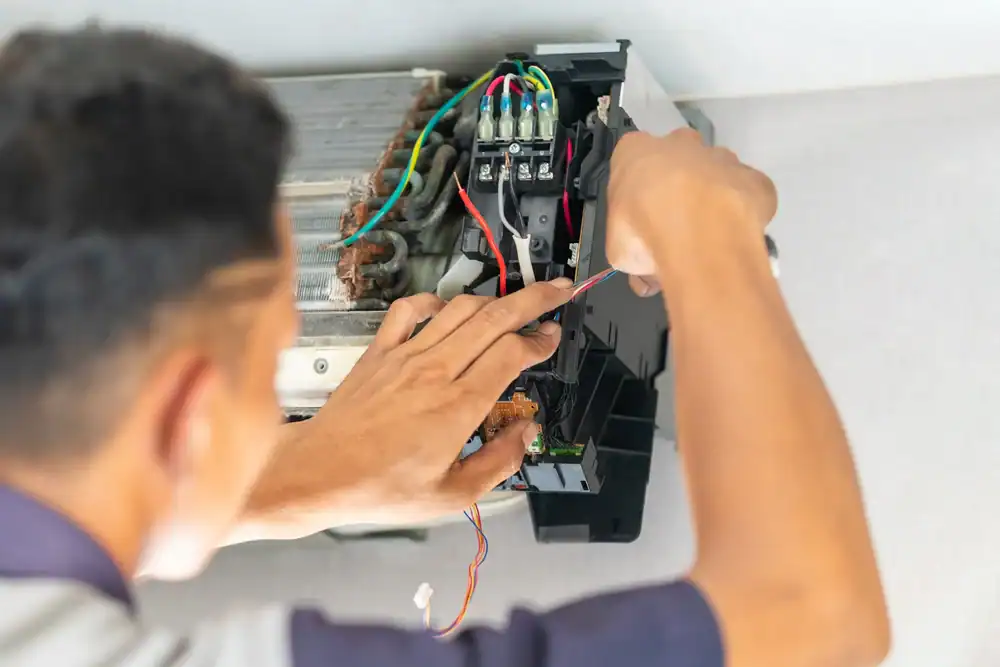
The evaporator coil — the indoor component that absorbs heat from your home’s air — isn’t always easy to get to. In a straightforward installation, we can swap it in two to four hours. But plenty of Essex County homes weren’t built with easy HVAC access in mind.
A 1920s Victorian in Montclair, a postwar split-level in West Orange, a mid-century Colonial in Bloomfield — these homes often have mechanical rooms that weren’t designed for modern air handlers. Coils in attics, crawl spaces, or tight utility closets take significantly more labor time to access and replace. That access difficulty can add 20 to 40 percent to the labor portion of the job alone.
Then there’s the coil type. The most common residential configuration uses what’s called an A-coil — a triangular unit that sits above the furnace or air handler. These are the most affordable to replace. N-coils and Z-coils, which appear in newer high-efficiency systems, cost more because the components themselves are pricier and the installation is more involved. Slab coils, often found in horizontal air handlers in attic spaces, add both parts and labor costs.
Size matters too. A larger home with a 4-ton or 5-ton system needs a larger coil, and that coil costs more than one for a smaller 1.5- or 2-ton system. Most residential systems in Essex County fall in the 2- to 4-ton range, but the difference in material cost between those two ends is meaningful.
Finally, if the replacement coil doesn’t precisely match your outdoor condenser unit’s efficiency rating, you can lose 20 percent or more of your system’s total efficiency — even with a brand-new coil installed. That mismatch problem is more common in older homes where the outdoor unit and indoor air handler were installed years apart, or where a previous contractor made a substitution that wasn’t fully compatible.
How the R-410A Phase-Out Is Affecting Coil Repair Costs in NJ Right Now
Here’s something the generic cost guides haven’t caught up to yet: as of January 1, 2025, production of R-410A refrigerant — the type used in most residential AC systems installed between roughly 2010 and 2023 — has stopped under EPA regulations. The refrigerant itself isn’t banned; existing systems can still be serviced and recharged. But as supply tightens, the cost to do so is rising.
When we replace an evaporator coil, the refrigerant has to be recovered, the new coil is installed, and then the system is recharged. That recharge is a real line item. Homeowners currently pay $40 to $90 per pound for R-410A installed, and a full recharge typically requires two to four pounds per ton of cooling capacity. On a 3-ton system, that’s potentially 12 pounds of refrigerant — and those costs will keep climbing as supply shrinks.
For Essex County homeowners with systems in the 10-to-15-year range, this matters. It doesn’t make coil replacement automatically wrong, but it does change the long-term math. A repair that made obvious financial sense two years ago now requires a more careful look at what that refrigerant recharge is actually going to cost — and what it might cost the next time the system needs attention.
If your system is older and uses R-22 — the refrigerant common in systems installed before 2010 — the calculation is even clearer. R-22 production ended years ago, and the remaining supply is extremely expensive. Replacing an evaporator coil on an R-22 system is almost never the right financial move. Full system replacement is the standard recommendation in that situation, and any honest contractor will tell you the same.
The refrigerant question isn’t a side note. It’s often the deciding factor between “fix the coil” and “replace the whole system.” If you don’t know what refrigerant your system uses, that’s one of the first things we’ll tell you when we diagnose the problem.
Home AC Coil Replacement Cost vs. Full System Replacement: How to Decide
This is the real question. And it deserves a straight answer, not a hedge.
If your system is under eight years old and still under warranty, replacing the coil almost always makes sense — you’re likely paying only for labor and refrigerant, not the coil itself. If your system is between eight and twelve years old, in otherwise good condition, and uses R-410A, coil replacement can still be the right call — but it warrants a full system evaluation, not just a coil quote.
If your system is twelve to fifteen years old or older, the math shifts. A new coil on an aging system is still attached to an aging compressor, blower motor, and capacitors. The coil fix doesn’t reset the clock on the rest of the system.
The Repair-vs.-Replace Rule of Thumb Essex County Homeowners Should Know
There’s a practical guideline that holds up well in the real world: if the cost of repairing the evaporator coil approaches one-third to one-half the cost of replacing the entire system, replacement is usually the smarter long-term investment. That’s not a hard rule, but it’s a useful filter.
Here’s a more concrete way to think about it. If a repair buys you three or more years of reliable cooling, it’s probably worth doing. If it buys you six months before the next component fails, it’s not. The age of the system, the refrigerant type, and the overall condition of the equipment all factor into that honest assessment.
Essex County’s housing stock skews older. A significant portion of homes in Montclair, Bloomfield, Glen Ridge, and Newark were built before 1980, and many of those homes have HVAC systems that are approaching or past the 15-year mark. That context matters when we’re standing in your mechanical room quoting you a coil replacement. The question isn’t just whether the coil can be replaced — it’s whether replacing it is the financially sound move given everything else the system has going on.
One more thing worth knowing: the average cost of a full residential HVAC system replacement has risen substantially in recent years, driven by material costs, new efficiency standards, and the refrigerant transition. In a county where 56 percent of homes carry a Severe Heat Factor rating and summers are only getting hotter, a functioning, efficient AC system isn’t optional.
What to Ask Before You Approve Any Evaporator Coil Repair in Essex County
Before you sign off on a coil replacement — or a full system swap — there are a few questions worth asking us or any contractor.
First, ask what refrigerant the system uses. If it’s R-22, the conversation about repair is essentially over. If it’s R-410A, ask what the refrigerant recharge will cost as part of the job, and what that cost trajectory looks like over the next few years given the phase-out.
Second, ask whether the replacement coil is a matched component for your outdoor condenser. A mismatched coil and condenser can drop your system’s efficiency by 20 percent or more — meaning you’ve paid for a repair that makes your energy bills worse, not better.
Third, ask the technician to walk you through the diagnostic findings. A legitimate diagnosis involves more than a glance at the unit and naming a part. You should be able to understand what was tested, what the results showed, and why the coil is the identified problem rather than something less expensive. If a contractor can’t or won’t explain that clearly, that’s a signal.
Federal law under EPA Section 608 requires any technician who handles refrigerants to be certified. In New Jersey, contractors performing HVAC work on your home must hold a valid NJ HVACR Contractor License. We hold NJ HVAC License No. 19HC00022600 — publicly searchable through the NJ Division of Consumer Affairs — and our technicians are EPA 608 certified. That’s not a selling point so much as a baseline expectation you should hold any contractor to.
If you’ve already received a quote and something feels off — the number is higher than you expected, the diagnosis wasn’t explained clearly, or you’re just not sure — getting a second opinion is completely reasonable. We offer free estimates, and we’ll tell you honestly what we find, including if the answer is that the other contractor was right.
Getting an Honest Evaporator Coil Assessment in Essex County, NJ
The evaporator coil question comes down to this: cost, system age, refrigerant type, and honest guidance from someone who isn’t trying to sell you something you don’t need. That’s a short list, but it’s the right one.
We’ve been doing this work in Essex County since 1973. We’ve replaced coils in Montclair Victorians, West Orange ranches, and Newark apartment buildings — and we’ve also told plenty of homeowners that replacement made more sense than repair. That’s how we’ve kept 500+ five-star Google reviews over fifty years of business.
If your AC is struggling and you want a straight answer about what’s wrong and what it’ll actually cost to fix, reach out to Adriatic Aire. Same-day service is available, estimates are free, and financing is available through FTL Finance if the repair or replacement is a bigger number than you were expecting. We’ll tell you what we find — and what we’d do if it were our home.
Article details:
- Published by:
- Adriatic Aire LLC
- Published to:
- Last modified:
- September 29, 2026
Share:
Continue learning: