Emergency Heating Repair in Essex County, NJ: Assess Your Situation Fast
Share:

It’s 11 PM. The thermostat reads 58°F and it’s still dropping. Your furnace isn’t responding, the kids are already under extra blankets, and you’re not sure whether to call someone right now or wait until morning. That moment — that exact moment — is what this guide is for.
Essex County winters don’t give you a lot of margin. When a heating system fails during a cold snap, the situation can go from uncomfortable to genuinely unsafe faster than most people expect. We’ll walk you through how to assess what’s happening, what it means, and what your next move should be.
Is This a True Heating Emergency or Can It Wait?
Not every heating problem is a 2 AM phone call. But some absolutely are — and the difference matters. The clearest signal that you’re dealing with a genuine emergency is indoor temperature. Once the inside of your home drops below 50°F, you’re no longer dealing with a comfort issue. You’re dealing with a safety issue, especially if you have young children, elderly family members, or anyone with a medical condition in the house.
Other situations that put you squarely in emergency territory: you smell gas near your furnace or boiler, you see sparks or scorch marks near the unit, or your carbon monoxide detector has gone off. Those aren’t “schedule something for tomorrow” problems. Those require an immediate call and, in the case of gas or CO, getting everyone out of the house first.
What to Check Before You Call for Same-Day Service
Before you pick up the phone, there are a few things worth checking — not because you should try to fix it yourself, but because the answer might be simple, and it helps to know what you’re dealing with when you do call.
Start with the thermostat. Make sure it’s set to heat, that the temperature is set above the current room temperature, and that it has power. Dead batteries in a smart thermostat have caused more than a few unnecessary emergency calls. If the thermostat looks fine, check your circuit breaker. A tripped breaker is a quick reset, though if it trips again immediately, stop there and call a professional — that’s a sign of a deeper electrical issue.
Next, check your air filter. A severely clogged filter can cause a furnace to overheat and shut itself off as a safety measure. If the filter looks like it hasn’t been changed in a year or more, replacing it might get the system running again. If it doesn’t, at least you’ve ruled it out.
For homes with boilers — and there are many throughout Essex County, particularly in the older neighborhoods of Montclair, Glen Ridge, and South Orange — check the pressure gauge. Most residential boilers should read between 12 and 25 PSI when cold. If it’s reading near zero, the system may have lost water pressure and won’t fire. That’s a call to a technician, but it’s useful information to have ready.
What you should not do: attempt to relight a gas pilot if you smell gas, open up electrical panels, or try to bleed a boiler system without knowing exactly what you’re doing. These aren’t tasks that save time — they’re tasks that create risk. If you’ve run through the basics and the system still isn’t responding, that’s when you call.
The goal of this quick check isn’t to become your own HVAC technician. It’s to give you 60 seconds of useful information so that when you do call, you can describe the situation clearly and the technician can come prepared.
What Happens When a Technician Arrives for Heating and Air Service
Once you’ve made the call, here’s what a proper emergency heating repair visit should look like — because knowing what to expect takes some of the anxiety out of an already stressful situation.
Our technician arrives, assesses the system, and explains what they’re finding before doing anything. That’s not just good customer service — it’s the standard. You should know what’s wrong, what it will take to fix it, and what it will cost before any work begins. If a technician is vague about the problem or pushes you toward a full system replacement without a clear explanation, that’s worth paying attention to.
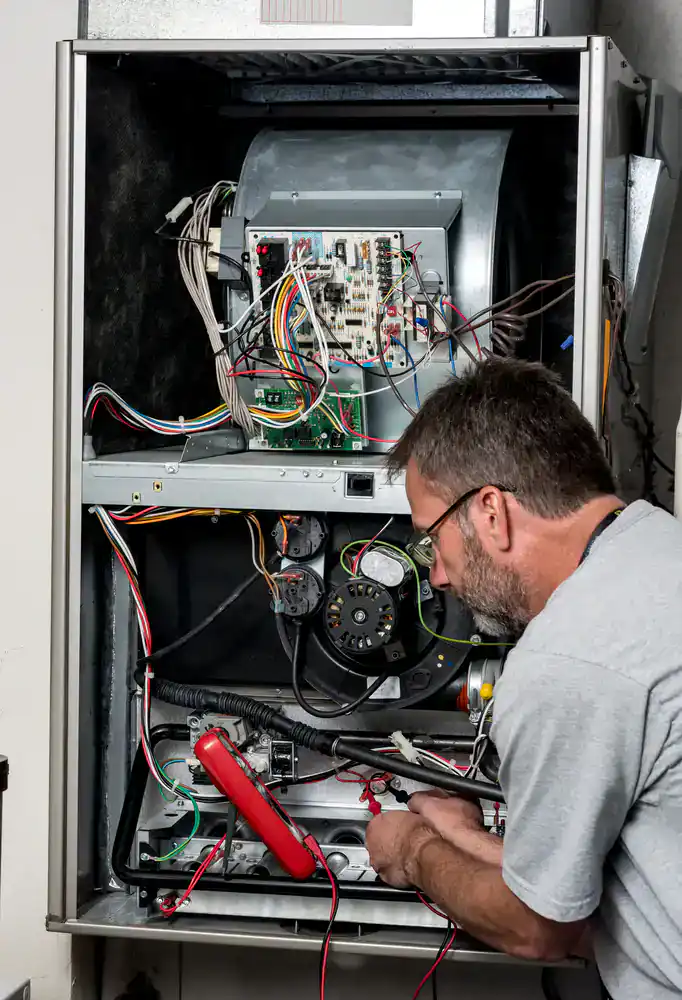
The most common heating failures we see in Essex County homes aren’t catastrophic. Ignitor failures, blower motor issues, zone valve problems, and pressure relief valve faults account for a significant share of emergency calls — and many of them are repairable in a single visit. Older boiler systems, which are common in the pre-war and post-war housing stock throughout the county, tend to have specific failure patterns that our experienced technicians recognize quickly.
After the repair is made, our technician walks you through what was done and what to watch for. If the system is aging and showing signs of wear beyond the immediate failure, we’ll mention it — not as a sales pitch, but as useful information for planning ahead.
Heat and Air Repair in Essex County: Why Local Experience Matters
Essex County isn’t a generic HVAC market. The housing stock here skews older — much of it built before 1970, with steam boiler systems, cast-iron radiators, and aging furnaces that have been running through New Jersey winters for decades. A technician who has worked in this county for years knows the failure patterns specific to these systems. That institutional knowledge matters when it’s cold and you need the problem diagnosed correctly on the first visit.
We’ve been doing this work in Essex County since 1973. That’s more than 50 years of winters in this market — through cold snaps, aging infrastructure, and the full range of systems that homeowners here rely on. It’s not a credential we mention to impress anyone. It’s the reality of what local experience looks like when it’s genuine.
Why Your HVAC Contractor’s New Jersey License Matters
It matters more than most homeowners realize, and New Jersey is one of the stricter states on this front. To legally perform HVAC work in NJ, a contractor needs a Master HVACR License — and earning that license requires completing a four-year DOL-approved apprenticeship, documented journeyperson experience, passing a state board exam, carrying a $3,000 surety bond, and maintaining $500,000 in general liability insurance. This isn’t a formality. It’s a meaningful filter that separates qualified professionals from people operating without accountability.
When you’re calling someone at midnight because your heat is out, you’re making a fast decision under pressure. The last thing you want to find out later is that the person who worked on your system wasn’t licensed or insured. In an emergency, it’s easy to skip the vetting step — which is exactly why it’s worth knowing in advance who you’d call.
We hold NJ Master HVACR License No. 19HC00022600, and we’ve been HomeAdvisor Screened and Approved for five consecutive years, which includes background checks and ongoing license verification. Essex County homeowners have given us a 5.0-star rating across more than 500 Google reviews. That volume of feedback reflects what happens when a technician explains the problem clearly, quotes a fair price, does the work as quoted, and doesn’t push for more than the situation requires.
How to Avoid a Heating Emergency: What Essex County Homeowners Often Miss
Most heating emergencies don’t come out of nowhere. They’re the end result of a system that’s been showing small signs of trouble for a while — signs that are easy to dismiss when the heat is technically still working. A furnace that takes longer than usual to kick on, a boiler that’s been making intermittent knocking sounds, uneven heat between rooms, a system that cycles on and off more frequently than it used to. These are warning signs, not quirks to get used to.
Homeowners who schedule regular maintenance are significantly less likely to face a true heating emergency. The systems that tend to fail in the middle of a cold snap are overwhelmingly ones that haven’t been serviced in years. The average HVAC unit in the U.S. is already past its design lifespan — and in Essex County, where a large share of homes are running systems that predate the turn of the century, the risk is higher than average.
There’s also a cost dimension. Emergency repairs during peak winter months carry a premium over standard service calls — demand is high, technician availability is stretched, and parts procurement under time pressure isn’t cheap. A system that fails in January costs more to fix than the same repair scheduled in October.
The practical takeaway is simple: if your heating system hasn’t been looked at in a year or more, fall is the right time to schedule a maintenance visit. Not because something is definitely wrong, but because finding out before the first hard freeze is a much better situation than finding out during one. We offer annual heating maintenance programs for exactly this reason — to help Essex County homeowners stay ahead of the problem rather than react to it.
Emergency Heating Repair in Essex County: What to Do Right Now
If your heat is out and you’re reading this in the middle of a cold night, here’s the short version: check the basics, rule out the simple stuff, and if the system still isn’t responding — or if you smell gas, see sparks, or your indoor temperature is dropping into unsafe territory — call for emergency service. Don’t wait until morning if the situation is genuinely urgent.
If you’re reading this before anything has gone wrong, that’s the better position to be in. Knowing who you’d call, knowing what questions to ask, and having a maintenance visit on the calendar before December are the things that keep a heating problem from becoming a heating emergency.
Adriatic Aire has been serving Essex County homeowners since 1973, and we offer 24/7 emergency service, same-day availability, and free estimates on every project. When you’re ready to talk — whether it’s tonight or next month — we’re the call to make.
Article details:
- Published by:
- Adriatic Aire LLC
- Published to:
- Last modified:
- September 22, 2026
Share:
Continue learning: