Why Your AC Is Blowing Cold Air But Not Cooling the House
Share:
You can feel air coming through the vents. The thermostat is set where it always is. The outdoor unit is humming. And yet the house is still 82 degrees at 4 in the afternoon. If that’s where you are right now, you’re not imagining things — and you’re not alone. This is one of the most common calls we get from homeowners across Essex County during the summer, and there’s almost always a clear reason behind it. The good news is that some causes are easy to identify. Others need a technician. This article will help you figure out which situation you’re in.
Why Your AC Is Running But Not Cooling
The first thing to understand is that airflow and cooling are two separate things. Your blower fan can run perfectly — pushing air through every vent in the house — while the actual cooling system is failing quietly in the background. So the fact that air is moving doesn’t tell you much about whether the refrigerant circuit, the compressor, or the coils are doing their job.
This distinction matters because it changes how you diagnose the problem. You’re not looking for why the system is off. You’re looking for why a system that appears to be on has stopped cooling.
What You Can Check Yourself Before Calling Anyone
There are a few things worth ruling out before you pick up the phone, and they take less than ten minutes to check.
Start with your air filter. A clogged filter restricts airflow so severely that the system can’t move enough air across the evaporator coil to cool the space — and in some cases, it causes the coil to freeze over entirely, which makes things worse. If the filter looks like it hasn’t been changed in months, swap it out and give the system thirty minutes to recover before drawing any conclusions.
Next, look at your thermostat settings. This sounds obvious, but it’s a more common culprit than most people expect. If the fan is set to “ON” instead of “AUTO,” the blower runs continuously — including between cooling cycles — which means it’s pushing room-temperature air through the vents even when the system isn’t actively cooling. You feel air, so you assume it’s working. It isn’t. Switch the fan to “AUTO” and see if that changes things. Also confirm the system is set to “COOL,” not “HEAT.” In Essex County, where spring mornings can be in the 40s and afternoons hit the mid-80s, it’s easy to flip the mode and forget to flip it back.
Finally, go outside and look at your condenser unit. If it’s buried in overgrown shrubs, packed with grass clippings, or visibly dirty on the coil fins, it can’t release heat properly — and a system that can’t shed heat can’t cool your home. You can gently rinse the coil fins with a garden hose if debris is the obvious issue, but don’t force water into the electrical components.
If you’ve checked all three of those and the house still isn’t cooling, the problem is something that requires a technician.
When the Problem Is Beyond a Filter or Thermostat Fix
The causes that require professional diagnosis tend to fall into a few categories, and some are more urgent than others.
A refrigerant leak is one of the most common reasons a home AC is running but not cooling. Refrigerant is the substance that actually absorbs heat from your indoor air — without enough of it, the system blows air but can’t cool it. Refrigerant doesn’t get “used up” the way fuel does. If it’s low, there’s a leak somewhere in the system. Simply adding more refrigerant without finding and sealing the leak is a temporary fix that will fail again. Under federal EPA regulations, only certified technicians can legally handle refrigerants — this isn’t just a safety rule, it’s a compliance requirement.
A frozen evaporator coil is another common culprit, and it often shows up as the system running constantly without cooling the house. The evaporator coil sits inside your air handler and absorbs heat from the air passing over it. When airflow is restricted — from a dirty filter, a closed register, or low refrigerant — the coil gets too cold and ice builds up on it. Once it’s frozen, it can’t absorb heat at all. If you suspect this, turn the system off and let it thaw completely before running it again. But the ice is a symptom, not the cause — whatever created the conditions for freezing needs to be fixed or it will happen again.
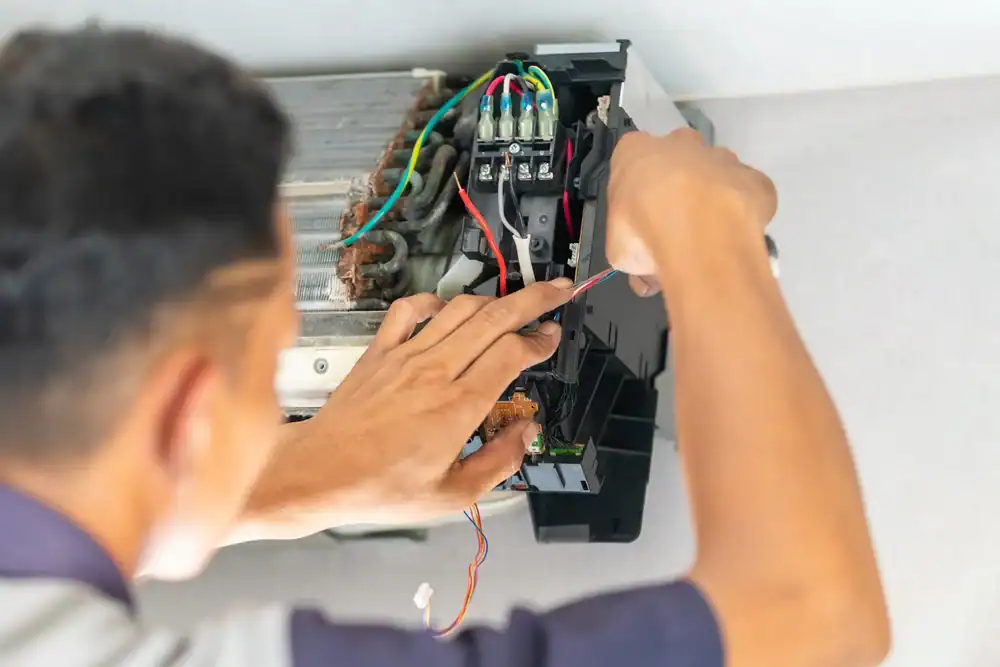
A failing capacitor is worth mentioning because it often looks like a compressor problem when it isn’t. The capacitor is what gives the compressor and fan motors the electrical jolt they need to start. When it weakens or fails — which happens more frequently during heat waves, because sustained heat stresses electrical components — the compressor may not start at all, even while the fan keeps spinning. From outside, the unit looks like it’s running. Inside, nothing is cooling. Capacitor replacement is a relatively straightforward repair for a licensed technician, and it’s far less expensive than a compressor replacement.
Ductwork leaks are a less obvious cause, particularly in older Essex County homes. If conditioned air is escaping into an unconditioned attic or wall cavity before it reaches your living space, the system can run all day without making a meaningful dent in the indoor temperature. Many homes in Montclair, Glen Ridge, Bloomfield, and West Orange were built in the early-to-mid 20th century — central air was added later, often with ductwork that was retrofitted rather than purpose-built. Duct leaks in these homes are common and frequently go undiagnosed for years.
How to Decide Whether to Repair or Replace Your AC
This is the question most homeowners are quietly dreading by the time they call. Nobody wants to spend money on a repair that just delays an inevitable replacement — but nobody wants to replace a system that had years of life left in it either.
The honest answer is that it depends on a few factors: the age of the system, the nature of the repair, and whether the system has been having recurring problems. A straightforward repair on a system that’s seven years old and has been well-maintained is almost always worth doing. A compressor replacement on a fifteen-year-old system with a history of issues is a much harder call.
What Repair Costs Actually Look Like
Having a realistic sense of what different repairs cost helps you evaluate your options without feeling like you’re flying blind.
A diagnostic service call typically runs between $75 and $200, and many contractors apply that fee toward the cost of the repair if you move forward. Refrigerant leak repair ranges from $200 to $1,500 depending on how severe the leak is and where it’s located — a minor leak in an accessible line is on the lower end, while a leak in the evaporator coil itself can push toward the higher end. Evaporator coil replacement, if it comes to that, typically falls between $1,000 and $4,500 or more depending on whether the coil is still under warranty. Ductwork leak repair generally runs $200 to $700. HVAC labor rates in the area average $75 to $150 per hour, with emergency or after-hours calls running higher.
We’d rather you understand the range going in than feel blindsided when a technician gives you an estimate. We’ve been serving Essex County since 1973, and our reputation is built on giving people honest answers, not on selling them things they don’t need.
Why Essex County Summers Are Especially Hard on AC Systems
Essex County summers are genuinely hard on AC systems in ways that don’t apply everywhere. July and August bring sustained heat and humidity that push systems to their limits for weeks at a time — and the combination of heat and moisture creates specific problems that show up more often here than in drier parts of the country.
New Jersey’s humidity means your AC is removing a significant amount of moisture from the air in addition to heat. That moisture has to go somewhere — it drains through a condensate line. When that line gets clogged with algae or debris, which happens faster in humid climates, a safety float switch can shut the system down entirely or restrict its operation. The system appears to be running, but it’s not cooling because it’s been partially disabled to prevent water damage. This is a maintenance issue, not a mechanical failure, but it’s one that catches a lot of homeowners off guard.
The older housing stock in towns like Montclair, South Orange, Glen Ridge, and Bloomfield adds another layer. Many of these homes were built before central air conditioning was standard, and the HVAC systems were added later — sometimes with ductwork that runs through unconditioned attic spaces, or with equipment that was sized for a different era’s insulation standards. If your home AC is running but not cooling and the house is older, duct leaks and airflow restrictions are worth investigating early in the diagnostic process.
There’s also the urban heat island effect in Newark and East Orange, where dense development and limited tree cover push ambient temperatures several degrees higher than surrounding areas. A system that’s sized for a standard summer day can struggle to keep up when the effective outdoor temperature is consistently higher than the forecast says. If you’re in one of those communities and your AC is on but not cooling the house to your set temperature, the system may not be failing — it may simply be undersized for the actual heat load it’s fighting.
We serve homeowners across Essex County — Montclair, West Orange, Bloomfield, South Orange, Maplewood, Glen Ridge, Livingston, Millburn, Nutley, Belleville, East Orange, Newark, Irvington, Cedar Grove, and Verona — and we’ve seen all of these scenarios play out in every kind of home the county has to offer.
AC Still Not Cooling? Here’s What to Do Next
If you’ve worked through the basics — filter, thermostat, outdoor unit — and the house is still not cooling, you’re past the DIY phase. The underlying cause is something that needs a trained eye and the right tools to diagnose properly, and waiting tends to make it more expensive, not less. A refrigerant leak that goes unaddressed long enough can damage the compressor. A frozen coil that keeps refreezing eventually causes the same problem.
The most important thing at this point is getting an honest diagnosis from someone who will tell you what’s actually wrong — not what generates the biggest repair ticket. That’s what we’ve built our name on over the past fifty years in Essex County.
If your AC is running but your house isn’t cooling, reach out to Adriatic Aire. We’re available 24 hours a day, seven days a week, and we offer same-day service. We’ll give you a straight answer about what’s wrong and what it will take to fix it.
Article details:
- Published by:
- Adriatic Aire LLC
- Published to:
- Last modified:
- July 14, 2026
Share:
Continue learning: