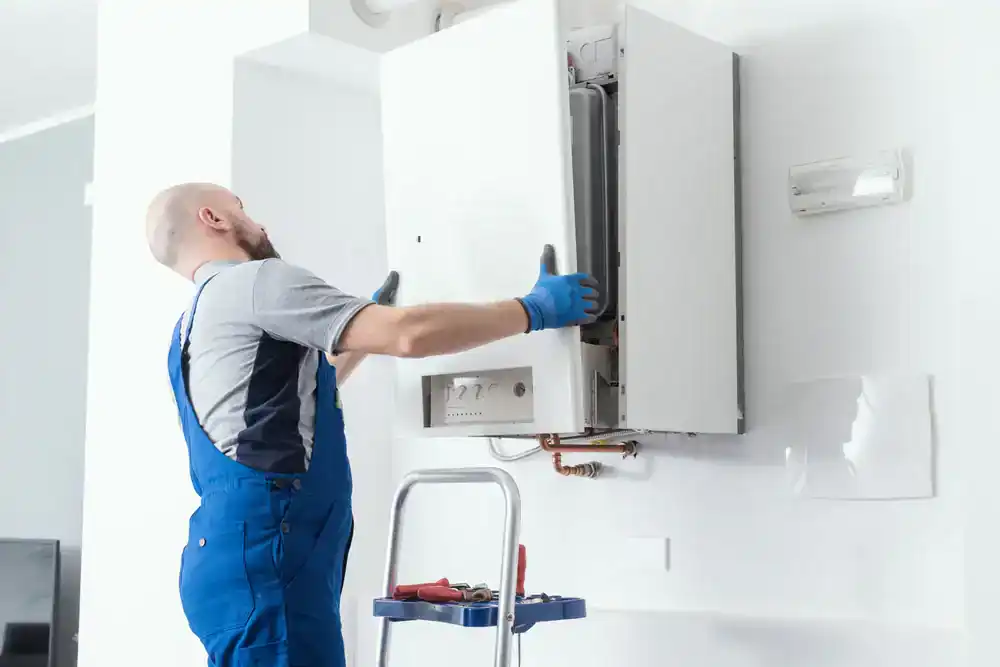
How Financing Works for a New Furnace or Boiler Install
Facing a boiler replacement in Essex County? Here's how financing actually works — and how to make it work for you before the cold sets in.
Share:
Summary:
Your boiler stopped working. Or it’s limping along and you already know what’s coming. Either way, you’re now looking at a replacement cost that probably wasn’t in this month’s budget — and you’re trying to figure out how to handle it without making a decision you’ll regret. That’s exactly what this page is for. We’re going to walk you through how HVAC financing actually works, what the terms mean, what NJ-specific rebates are on the table, and how to avoid the traps that catch a lot of homeowners off guard. No pressure, no sales pitch — just a straight answer.
How HVAC Financing Works for a Boiler or Furnace Replacement
At its core, financing a new boiler or furnace works the same way as financing anything else — you borrow the money now, pay it back over time, and depending on the terms, you may or may not pay interest on top of the principal. The difference with HVAC financing is that it comes in several distinct forms, and which one makes sense for you depends on your credit, your timeline, and how much you’re financing.
The most common path is promotional financing through us or the equipment manufacturer. This typically means a 0% interest period — usually 12 to 24 months — during which you make monthly payments with no interest added. If you pay the balance in full before that period ends, you’ve borrowed money for free. If you don’t, interest kicks in retroactively, often at rates of 18% or higher. That’s the part a lot of homeowners don’t read carefully enough.
What Are Your Actual Financing Options in Essex County?
There’s more than one path here, and knowing the difference can save you real money. We work with lending partners who specialize in home improvement loans, and the application is typically fast. Approval is based on credit score and income, and qualified buyers can access promotional 0% APR periods or longer-term fixed-rate loans ranging from 25 to 72 months. Monthly payments on a longer-term loan will be lower, but you’ll pay more in total interest over time. That’s a trade-off worth understanding before you commit.
Manufacturer financing is similar in structure. Brands like Trane, Lennox, and Weil-McLain — systems we install regularly — often have their own financing programs through partner banks. These tend to mirror what we offer: promotional periods, then standard interest. The terms vary by program and timing, so it’s worth asking specifically what’s available at the moment you’re ready to move forward.
Then there’s a third option that most contractors never mention: utility On-Bill Repayment programs. These are NJ state-supported financing programs where your repayment is added directly to your monthly utility bill. The significant advantage is that eligibility is based on your utility payment history, not your credit score. For homeowners in Essex County who’ve had credit challenges in the past, this can be the path that makes a new heating system genuinely accessible — at 0% interest, no less. PSE&G, which serves most of Essex County, participates in programs like this. It’s worth asking about before you assume financing isn’t an option for you.
Some homeowners also opt for a personal loan through their bank or credit union, particularly if they want a fixed rate and a predictable payoff date without any promotional-period risk. Rates vary widely depending on your credit profile, but for buyers with strong credit, this can be a clean, straightforward option that keeps the financing separate from the contractor relationship entirely.
Can You Stack NJ Rebates With Financing to Lower Your Monthly Payment?
Yes — and this is one of the most underused strategies in the market. Here’s how it works: rebates reduce the amount you need to finance before your first payment is even due. If you’re replacing a boiler with a high-efficiency model (AFUE of 90% or higher), you may qualify for a rebate through the NJ Clean Energy Program of up to $1,500. PSE&G customers — which covers a large portion of Essex County — may also qualify for instant equipment rebates of up to approximately $1,050. Those aren’t credits you wait on. In many cases, they’re applied at the point of installation, directly reducing the financed amount.
That matters more than it sounds. If you’re financing $8,000 and you qualify for $2,500 in combined rebates, you’re now financing $5,500. On a 48-month loan, that difference shows up in every single monthly payment for four years. It’s not a minor detail — it’s the difference between a payment that fits your budget and one that doesn’t.
One thing worth flagging: the federal Section 25C Energy Efficient Home Improvement Credit, which previously offered up to $600 for qualifying high-efficiency furnaces and boilers, expired for equipment placed in service after December 31, 2025. As of now, no federal replacement credit has been enacted for 2026 installs. State utility rebates remain available, but if you’ve been counting on the federal credit as part of your budget math, that number needs to come out of the equation. We’d rather tell you that upfront than have you find out at tax time.
We handle the rebate paperwork as part of the installation process. You shouldn’t have to track down forms and utility program details on your own when you’re already dealing with a heating system replacement.
What Essex County Homeowners Actually Ask About Boiler Financing
We hear the same questions from homeowners in Montclair, Maplewood, South Orange, West Orange, and Glen Ridge — towns where the housing stock skews older and boiler systems are the norm, not the exception. These aren’t abstract concerns. They’re the real questions that come up when someone is standing in a cold house trying to figure out what to do next.
Do You Need Good Credit to Finance a Boiler Replacement in Essex County?
It depends on which financing path you’re using. For contractor-arranged or manufacturer financing, yes — approval is typically credit-based, and a stronger credit score will get you better terms and lower rates. But “good credit” doesn’t mean perfect credit. Many financing programs work with a range of credit profiles, and a pre-qualification check won’t affect your credit score.
If your credit is more complicated, the utility OBR programs we mentioned earlier are genuinely worth exploring. Because eligibility is based on your history of paying your utility bills rather than your credit score, they open the door for homeowners who might get turned down through traditional channels. Essex County has a wide range of homeowners — from longtime residents of Belleville and Irvington to newer buyers in Caldwell and Verona — and not everyone comes to this conversation with a clean credit file. That doesn’t mean financing is off the table. It means you need to ask about the right programs.
There are also rent-to-own structures and alternative financing products designed specifically for buyers with challenged credit. These tend to carry higher effective costs over time, so they’re not the first choice — but they exist, and for someone who needs heat in January and has no other path forward, they’re worth knowing about.
The bottom line: don’t assume you don’t qualify before you ask. The range of options in New Jersey is broader than most homeowners realize, and we can point you toward the path that actually fits your situation.
Is It Smarter to Finance a New Boiler or Keep Paying for Repairs?
This is the question a lot of Essex County homeowners are really asking, even when they phrase it differently. And the honest answer is: it depends on the age and condition of your current system — but the math often surprises people.
Here’s a simple framework we use: multiply your boiler’s age by the cost of the repair being quoted. If that number exceeds $5,000, replacement typically makes more financial sense than repair. A 20-year-old boiler facing a $400 repair hits $8,000 on that scale — well into replacement territory. A 10-year-old boiler with the same repair comes out at $4,000, which may still be worth fixing depending on the system’s overall condition.
But there’s a layer the math alone doesn’t capture: efficiency. Older boilers — especially the cast-iron steam systems common in pre-1960 homes throughout Montclair, South Orange, and Glen Ridge — often run at significantly lower efficiency than modern high-efficiency units. That gap shows up in your gas bill every month. A new boiler rated at 90% AFUE or higher converts more of every dollar of fuel into actual heat, which means lower operating costs from day one. When you factor that monthly savings against a financing payment, the net cost of upgrading is often lower than people expect.
The repair cycle is also unpredictable in a way that financing isn’t. A $400 fix this year, a $600 part next year, another service call the year after — those costs add up without a clear endpoint, and they don’t come with any improvement in efficiency or reliability. A financed replacement locks in a known monthly cost, a manufacturer’s warranty, and a system that isn’t going to leave your family cold on a January night because something else failed.
We’ve been doing this work in Essex County since 1973. We’ve seen plenty of homeowners hold on to aging systems a few years longer than they should have, and we understand why — the upfront number is intimidating. But when we walk someone through the actual comparison, the decision usually becomes clearer than they expected.
Getting a Straight Answer on Boiler Financing in Essex County
Financing a new boiler or furnace doesn’t have to be confusing or stressful — but it does require someone who will give you the full picture before you sign anything. That means explaining the terms honestly, letting you know which rebates apply to your situation, and telling you when repair is actually the smarter call rather than pushing you toward a replacement you don’t need.
We’ve been working with Essex County homeowners since 1973, and the questions haven’t changed much. What’s the real cost? What are my payment options? Can I trust the contractor I’m talking to? Those are fair questions, and they deserve real answers — not a sales pitch.
If you’re weighing a boiler or furnace replacement and want to understand what financing would actually look like for your home and your budget, reach out to Adriatic Aire. We offer free estimates, we pull all required permits, and we’ll walk you through the numbers without pressure.
Article details:
- Published by:
- Adriatic Aire LLC
- Published to:
- Last modified:
- September 24, 2026
Share:
Continue learning: