What Boiler Service Actually Covers — And Why It Matters in Essex County
Share:

If your boiler is running, it’s easy to assume it’s fine. That’s the logic most homeowners use — and it’s the exact reason so many end up with a dead system on a January night when temperatures drop into the teens.
Boiler service isn’t a formality. It’s the difference between catching a cracked heat exchanger before it becomes a carbon monoxide problem and finding out about it the hard way. This page breaks down what a real boiler service actually involves, what gets missed when you skip it, and what Essex County homeowners — especially those with older steam systems — need to know before the heating season starts.
What Does a Boiler Service Actually Include?
A boiler service is not a technician glancing at your system for ten minutes and handing you a receipt. A proper service means opening the unit, getting into the components, and systematically checking everything that keeps the system running safely and efficiently.
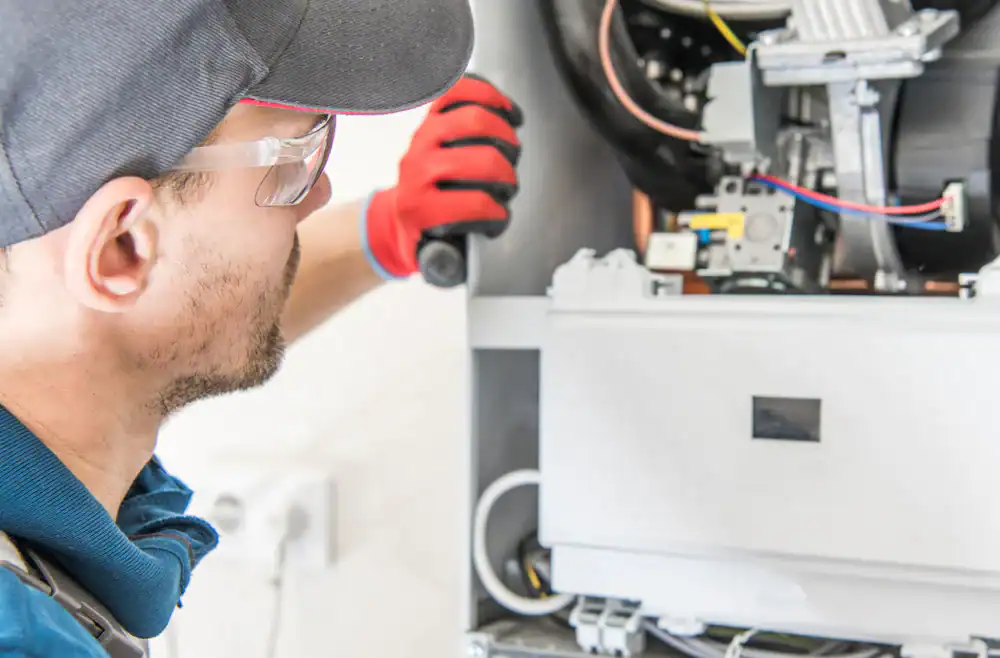
When we show up for boiler maintenance, here’s what we actually do: check the heat exchanger for cracks, test pressure levels, look for leaks around valves and connections, clean the burners and inspect the flame, verify that safety controls are functioning, check venting and gas connections, test the circulator pump, and bleed air from the lines if needed. That’s the full picture — not a checklist item, but a working inspection of a system that heats your home for six months a year.
Why the Heat Exchanger Check Is the Most Important Part
Of everything a boiler service covers, the heat exchanger inspection is the one that carries the highest stakes. A cracked heat exchanger can allow combustion gases — including carbon monoxide — to mix with the air circulating through your home. Carbon monoxide is colorless and odorless. You won’t smell it, and your boiler won’t act any differently. The only way to catch it is to look for it.
Heat exchangers develop cracks gradually, often over years, as the metal expands and contracts through thousands of heating cycles. A system that passed a visual check two years ago may have developed a crack since then. That’s exactly why annual service exists — not to generate a service call, but because the inspection interval matters.
For homeowners in Essex County’s older communities — Montclair, Glen Ridge, Maplewood, South Orange — this is especially relevant. Many of these homes were built in the early to mid-twentieth century and are still running their original or near-original boiler configurations. Older systems aren’t automatically dangerous, but they require more diligent inspection, not less. A technician who actually knows what they’re looking at in a 70-year-old steam system is a different thing entirely from someone who’s only ever worked on newer equipment.
Beyond the safety dimension, a compromised heat exchanger also means the system is working harder than it needs to. Combustion efficiency drops, fuel costs rise, and the wear on surrounding components accelerates. Catching a developing crack early — before it becomes a full failure — is one of the clearest examples of why scheduled maintenance costs less than reactive repair.
Steam Boiler Service vs. Hot Water Boiler Service — They’re Not the Same
One of the most common misconceptions we run into is that boiler service is boiler service — that every system gets the same treatment. It doesn’t, and in Essex County, that distinction matters more than most places.
A significant share of the homes in Montclair, Glen Ridge, and the older neighborhoods of Maplewood and South Orange were built with steam heating systems. One-pipe steam, two-pipe steam — these are configurations that require a fundamentally different service approach than a standard hot water boiler. Steam systems operate on pressure differentials, and the venting, water level management, and trap function all need to be evaluated with that in mind. A technician who treats a steam system like a hot water system isn’t doing a real service — they’re doing a partial one.
Hot water boilers have their own service requirements: circulator pump testing, zone valve inspection, pressure relief valve checks, and bleeding air from the lines to ensure even heat distribution. These systems are generally more straightforward, but “more straightforward” doesn’t mean self-maintaining. Circulator pumps wear out. Zone valves stick. Pressure builds in ways that stress connections over time.
The reason this matters practically is that not every HVAC company in Essex County is equipped to service both. We’ve been working on steam systems in this area since 1973 — the one-pipe configurations in Montclair’s Victorian-era homes, the two-pipe setups in Glen Ridge’s prewar colonials — and that depth of experience with legacy systems is genuinely different from general HVAC knowledge. If you’re not sure what type of system you have, that’s actually a good reason to have someone take a look before the heating season starts, not after.
Is Annual Boiler Service Actually Worth It?
This is the question most homeowners are really asking when they search for boiler service. The honest answer is yes — but not for vague reasons.
The concrete case for annual service comes down to a few things that compound over time: efficiency loss, warranty implications, and the cost difference between a scheduled visit and an emergency call. A boiler that hasn’t been serviced in several years is almost certainly operating below its rated efficiency. For older systems — which in Essex County often means units running at 60 to 70 percent efficiency — the gap between what you’re paying and what you should be paying in fuel costs is real money, season after season.
What Happens If You Skip Boiler Maintenance in Essex County?
The most immediate risk is a mid-season breakdown. Essex County winters regularly push below 20 degrees Fahrenheit, and a boiler failure in that kind of cold isn’t just uncomfortable — it’s a genuine problem, especially for households with young children, elderly residents, or anyone working from home and dependent on a livable temperature during the day.
When systems fail without warning, the repair cost is almost always higher than it would have been if the underlying issue had been caught during a routine service. A failing circulator pump, for example, is a relatively contained repair when it’s identified early. When it fails completely in February, you’re looking at emergency labor rates, potential damage to surrounding components, and however many days it takes to get a technician out during peak demand season.
There’s also the warranty issue, which catches a lot of homeowners off guard. If you’ve had a boiler installed in the last several years, your manufacturer’s warranty almost certainly requires documented annual professional service to remain valid. Skip a year, and a warranty claim on a failed component may be denied — meaning a repair that should have been covered comes out of pocket entirely.
For Essex County homeowners still running oil-fired boilers, there’s a separate conversation worth having. We don’t repair oil heating systems — our focus is on helping oil boiler customers convert to gas, which PSE&G serves throughout the county. If your oil system is aging and you’re starting to weigh repair costs against the alternative, that’s a conversation we’re well-positioned to have honestly, without pushing you toward a decision you’re not ready for.
How Often Should a Boiler Be Serviced, and When Should You Book It?
Every major boiler manufacturer — including Weil-McLain and US Boiler Company, both of which are common in Essex County homes — recommends annual professional service. That’s not a sales pitch; it’s the maintenance standard the equipment is designed around. The question isn’t really whether to service annually, but when.
The strategic window is late summer to early fall — August through October. That’s when service slots are available, when technicians aren’t stretched thin by emergency calls, and when any issues found during the inspection can be addressed before the heating season puts the system under full load. Waiting until November or December means competing with everyone else who also waited, and potentially going into winter with a known issue and a longer wait for parts or follow-up work.
A well-maintained boiler can last 15 to 30 years. That range isn’t random — it reflects the difference between a system that gets consistent professional attention and one that gets called in on only when something breaks. In Essex County, where a lot of the housing stock is already running older equipment, getting the most out of what you have often comes down to that annual visit.
One practical note: if you’re not sure when your boiler was last serviced, that’s worth finding out before the heating season. We’ve shown up to homes in Montclair and Bloomfield where the system hadn’t been professionally inspected in five or more years — running, yes, but running on borrowed time. The inspection itself tells you a lot. And if everything checks out, you go into winter with actual confidence instead of just hope.
Getting Your Boiler Serviced in Essex County, NJ — What to Do Next
Boiler service is one of those things that’s easy to postpone because the system appears to be working. But the problems that matter most — a developing crack in the heat exchanger, a circulator pump showing wear, pressure building in aging connections — don’t show up as obvious symptoms until they become failures.
If you’re in Essex County and haven’t had your boiler professionally serviced in the last year, the right time to schedule it is before the heating season, not during it. That’s true whether you have a steam system in a prewar Montclair home, a hot water boiler in a Livingston colonial, or an aging oil system you’re starting to think seriously about replacing.
We’ve been doing this work in Essex County since 1973, with 500+ Google reviews at 5.0 stars and an NJ HVACR license you can verify. No upselling, no surprises. If you want to know exactly where your system stands heading into winter, reach out to Adriatic Aire — we’ll give you a straight answer.
Article details:
- Published by:
- Adriatic Aire LLC
- Published to:
- Last modified:
- July 21, 2026
Share:
Continue learning: