Spring AC Tune-Up Checklist for Essex County, NJ Homeowners
Share:

There’s a window every spring — roughly April through May — where getting your AC serviced is easy, affordable, and stress-free. Miss that window, and you’re scheduling around everyone else who waited too long, hoping your system holds through July. In Essex County, where summer heat indexes regularly push past 95°F, that’s a gamble that doesn’t always pay off. This guide walks you through what a proper AC tune-up covers, what you can handle yourself, and what needs a licensed technician. By the end, you’ll know exactly what to do — and when.
What Air Conditioner Maintenance Actually Involves
A lot of homeowners think air conditioner maintenance means swapping the filter and calling it done. The filter matters — but it’s one piece of a much larger picture. A full tune-up covers the electrical components, refrigerant circuit, drainage system, coils, and more. Some of it you can handle on your own. Most of it requires a licensed technician with the right tools and certifications to do safely and correctly.
The goal isn’t just to confirm your system turns on. It’s to catch the small problems — a weakening capacitor, a clogged condensate drain, refrigerant levels that are slightly off — before they become the reason you’re calling for emergency service in the middle of August.
AC maintenance tasks you can do before the technician arrives
There’s real value in showing up to a tune-up with the basics already handled. It lets the technician focus on the technical work rather than starting from scratch on the straightforward stuff — and it keeps you more informed about what’s actually happening with your system.
Start with the air filter. If you haven’t replaced it since last fall, it’s overdue. A clogged filter restricts airflow across the evaporator coil, which forces the system to work harder and can cause the coil to ice over. Most one-inch filters should be replaced every one to three months during active use. If you have a thicker media filter, check the manufacturer’s recommendation — some are rated for six to twelve months.
Next, walk outside and look at your condenser unit. Clear away any debris that accumulated over winter — leaves, dirt, sticks, anything that got packed in around or against the unit. Give the fins a visual inspection. If they’re heavily bent or clogged with grime, that’s something to flag for the technician. You can rinse the exterior of the unit gently with a garden hose (low pressure, top-down), but skip the pressure washer — it can damage the fins.
Check the refrigerant lines running from the condenser into your home. They should be wrapped in foam insulation. If that insulation is cracked, missing in sections, or falling apart, note it. Degraded line insulation is common on older systems, especially in homes where the lines have been exposed to years of weather, and it affects efficiency.
Finally, take a look at your condensate drain line — the small PVC pipe that exits near your indoor air handler. If it’s clogged, water backs up and can cause real damage to walls, ceilings, and flooring. You can pour a cup of distilled white vinegar into the drain access point to help clear any buildup. It’s a simple step that a surprising number of homeowners skip entirely.
What we check during an AC tune-up
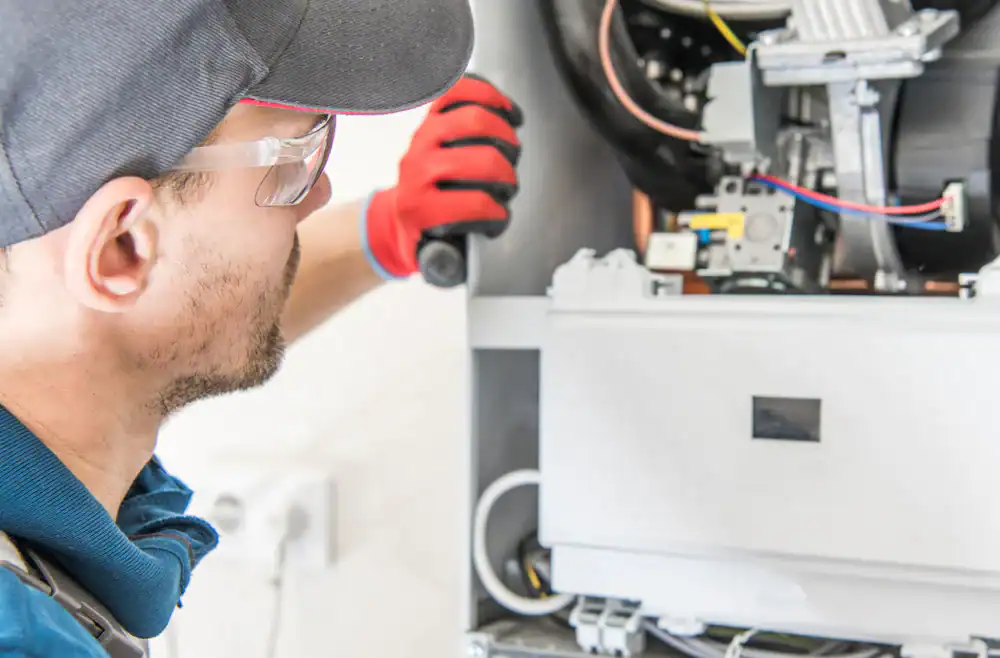
The professional side of an AC tune-up goes well beyond what’s visible from the outside. We install gauges to measure operating pressures and temperatures, then compare those readings against manufacturer specifications. That data tells us whether the refrigerant charge is correct — too little refrigerant means the system can’t cool efficiently; too much creates its own set of problems. Either way, you won’t know there’s an issue until the system starts struggling on a 90-degree day.
Capacitors and contactors get inspected next. These are the electrical components that start and run your compressor and fan motors. Capacitors degrade over time — they look fine visually but lose their ability to hold a charge. A failing capacitor is one of the most common causes of midsummer AC breakdowns, and it’s also one of the easiest things to catch during a tune-up. Replacing one proactively is far less disruptive than replacing one when your system refuses to start on a Friday afternoon in July.
We’ll also clean the evaporator and condenser coils if needed. Dirty coils reduce the system’s ability to transfer heat, which drives up your electricity consumption and puts extra strain on the compressor. We check the blower motor, verify thermostat calibration, inspect all electrical connections for corrosion or looseness, and confirm the disconnect box is properly sealed and wired. The disconnect box detail matters more than most people realize — loose connections inside it are a fire risk, not just an efficiency issue.
In Essex County, where a significant portion of the housing stock dates from the early to mid-20th century, this kind of thorough inspection often turns up issues that newer construction rarely sees: aging ductwork with gaps or disconnections, refrigerant lines with compromised insulation, and equipment that’s been patched together over decades. A technician who’s familiar with older systems — and knows what to look for in a home built in 1940 versus 2005 — is going to give you a more accurate picture of where things stand.
AC cleaning: the part most people underestimate
Cleaning isn’t the glamorous part of an AC tune-up, but it’s often where the most value is. A dirty system doesn’t just run less efficiently — it runs harder, wears out faster, and costs more to operate month over month. The U.S. Department of Energy has noted that a well-maintained HVAC system uses 15 to 20 percent less energy than a neglected one. Over the course of a summer in Essex County, that adds up.
The two coils — evaporator (indoor) and condenser (outdoor) — are the primary targets. Both accumulate grime over time, and both need to be clean to do their job. The condensate drain line, as mentioned earlier, is another cleaning priority that often gets overlooked until it causes a visible problem.
Why skipping AC cleaning costs you more in the long run
Here’s a number worth keeping in mind: a professional AC tune-up typically runs between $175 and $550, with most homeowners paying around $250. If refrigerant needs to be added, that’s an additional $100 to $350 depending on how much is needed. That’s the full range of what a spring tune-up costs.
Now consider the alternative. A compressor failure — often the downstream result of years of neglected maintenance — can cost well over $1,500 to repair or replace. Emergency HVAC service in July, when contractors are booked out and demand is at its peak, carries its own premium. The math isn’t complicated. A spring tune-up is the cheaper option by a significant margin, and it comes with the added benefit of knowing your system is actually ready for the heat rather than just hoping it holds.
There’s also a warranty consideration that most homeowners don’t know about. Many HVAC manufacturers require proof of regular professional maintenance to honor warranty claims. If your system fails and you haven’t kept up with annual service, you may be responsible for the full cost of repair or replacement — even if the equipment is still within its warranty period. A documented tune-up from a licensed contractor is the record that protects you if that situation ever comes up.
In Essex County specifically, this matters because many homes are running systems that are ten, fifteen, or twenty-plus years old. Older equipment isn’t necessarily a reason to replace — plenty of well-maintained systems run reliably for twenty years or more — but it does mean the margin for neglect is smaller. A system that’s been skipping annual service for several years is operating on borrowed time, and the failure, when it comes, tends to happen at the worst possible moment.
When AC cleaning reveals a central air repair need
Sometimes a tune-up turns up something that needs more than cleaning and calibration. A failing capacitor, a refrigerant leak, a cracked heat exchanger, a blower motor drawing too many amps — these are things we identify during a routine visit that the homeowner had no idea were happening. That’s not a failure of the tune-up process. That’s exactly what it’s designed to do.
The question homeowners often have at that point is: how do I know if I’m being told the truth? It’s a fair question, and one that comes up in our conversations with Essex County homeowners regularly. The honest answer is that you want a technician who can show you what they found — not just describe it — and who gives you a clear explanation of the repair, the cost, and the consequence of not doing it. A good technician will also tell you when something isn’t urgent, when you can monitor it through another season, and when a repair genuinely doesn’t make financial sense relative to the age of the equipment.
If a repair does turn out to be necessary, financing through FTL Finance is available for homeowners who’d rather spread the cost than pay it all at once. That option doesn’t change the diagnosis, but it does mean you’re not forced into a decision based purely on what’s in your account that week.
The other thing worth knowing: if a tune-up reveals that a system is genuinely at the end of its life, that’s a conversation worth having in April — not in late July when you’re without AC and under pressure to decide quickly. Spring gives you time to get multiple opinions, research your options, and make a decision that actually fits your home and your budget.
Ready to schedule your spring AC tune-up in Essex County?
The window for a stress-free spring tune-up is real, and it closes faster than most homeowners expect. Once temperatures climb and the calls start coming in, availability tightens and the stakes get higher. Scheduling in April or early May means you get the appointment you want, the system gets a thorough look before it’s under load, and you head into summer knowing where things stand.
If your AC hasn’t been serviced in the past year — or you’re not sure when it was last looked at — that’s reason enough to get it scheduled. We’ve been servicing homes across Essex County, NJ since 1973, with a team that knows how to work on systems of every age, make, and condition. Free estimates, same-day availability, and a record that speaks for itself. Give us a call before the heat makes the decision for you.
Article details:
- Published by:
- Adriatic Aire LLC
- Published to:
- Last modified:
- July 21, 2026
Share:
Continue learning: