Gas Boiler Replacement Costs in Essex County, NJ 2026
Share:
If you’ve gotten a repair quote that made you pause — or your boiler is old enough that you’re wondering how many winters it has left — you’re probably trying to figure out what a full replacement actually costs before you call anyone. That’s smart.
The problem is that most cost guides online give you national averages that don’t account for the older homes, the oil tanks in basements, or the PSE&G gas line coordination that comes with the territory here in Essex County. We’ve been installing boilers in these homes since 1973, and we know what the real numbers look like for homeowners in Montclair, Bloomfield, South Orange, and across the county.
This guide gives you the real costs specific to this market, so you can make a decision you’ll feel good about.
What Gas Boiler Replacement Actually Costs in Essex County, NJ
For a straightforward like-for-like replacement — swapping an existing gas boiler for a new one — most Essex County homeowners spend somewhere between $4,000 and $9,000 for a standard unit installed. High-efficiency condensing boilers, which run at 90–98% AFUE versus the 80–89% you’d get from a standard unit, push that range to $6,000–$11,000 installed.
The equipment itself typically runs $1,400–$6,500 before installation, depending on the brand, size, and efficiency rating. On top of that, you’re looking at permit costs — most NJ municipalities charge $50–$300 — plus old boiler removal and disposal, which typically adds another $200–$500. These aren’t surprises if you know to ask about them upfront, but they’re the kind of line items that can catch homeowners off guard when they’re comparing estimates.
What Makes One Boiler Replacement More Expensive Than Another
The biggest variable is usually the equipment itself. A basic 80% AFUE gas boiler for a smaller home might run around $2,000 for the unit alone. A high-efficiency condensing boiler for a larger Victorian in Montclair or a Colonial in Maplewood — the kind of home where the original system has been running for 25 or 30 years — will cost more, both in equipment and in labor.
Older systems often require additional work to bring the surrounding infrastructure up to spec. System type matters too. Hot water boilers and steam boilers are different animals. Steam systems, which are common in Essex County’s older housing stock, require more precision during installation and can’t just be swapped out with whatever’s cheapest on the shelf.
Proper sizing is critical regardless of system type — an oversized boiler will short-cycle, burning more gas and wearing itself out faster than a correctly sized unit would.
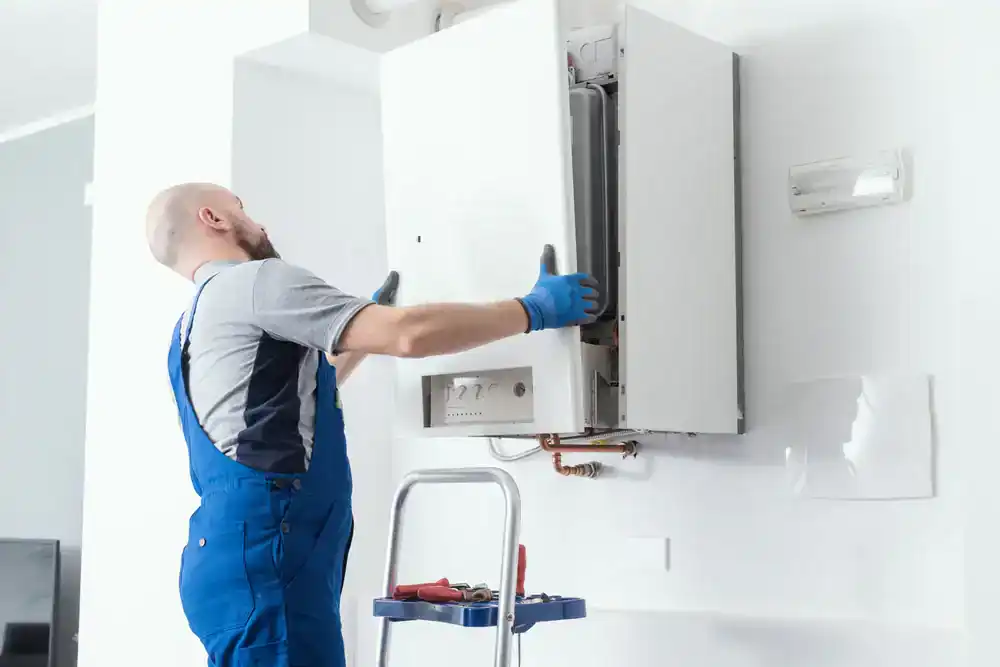
Labor typically accounts for around 30% of the total project cost. In the Essex County market, that translates to roughly $85–$125 per hour for a licensed HVAC technician, or a project total that reflects the full scope of work: disconnecting and removing the old system, installing the new one, testing all controls, and verifying the system is operating safely before we leave the job site.
One thing worth knowing: the permit isn’t optional. In New Jersey, boiler replacement requires a permit from the local building department. A contractor who suggests skipping it is putting you in a difficult position — unpermitted HVAC work can create problems with your homeowner’s insurance and complicate a future home sale. Every municipality in Essex County has its own process, and we’ve been pulling permits here long enough to know how to move that part of the project along without it becoming a bottleneck.
Repair vs. Replace: How to Know Which Decision Makes Sense
This is the question most homeowners are actually wrestling with when they start researching replacement costs. You’ve gotten a repair estimate, it’s higher than you expected, and now you’re wondering whether it makes more sense to fix what you have or put that money toward something new.
A 12-year-old boiler with a bad circulator pump is almost always worth repairing — the system has plenty of life left, and a circulator pump is a routine fix. A 28-year-old boiler with a cracked heat exchanger is a different conversation entirely. The heat exchanger is the core of the system. Replacing it on an old unit is expensive, and even after the repair, you’re still running aging equipment that could fail again in another season or two.
Here’s the general rule we use: if the cost of the repair exceeds 50% of what a new system would cost, and the boiler is more than 15 years old, replacement is usually the smarter financial move. That’s not a sales pitch — it’s just math. Spending $2,500 on a repair for a 25-year-old boiler that might need another $1,500 in work next winter doesn’t make as much sense as putting that money toward a new system with a manufacturer’s warranty and predictable performance.
Where it gets more interesting is when you’re on oil heat. Because then the repair-vs.-replace question isn’t just about the boiler — it’s about whether this is the moment to make the switch to natural gas entirely. That changes the math considerably, and it’s worth running through the numbers before you commit to either path.
Oil to Gas Conversion Cost for Essex County Homeowners
A complete oil-to-gas conversion in New Jersey — covering a new gas boiler, interior gas piping, permits, contractor labor, and oil tank removal — typically runs $12,000–$18,000. That’s a meaningful investment, and it deserves a clear-eyed financial analysis before you commit.
The good news is that the numbers tend to hold up well when you actually run them. The range is wide because the variables are real. How far does the gas line need to run inside your home? Is your oil tank underground or above-ground? Does your chimney need a liner to handle the new system’s exhaust? Each of those factors adds to the total, and the only way to get an accurate number for your specific home is to have someone walk through it with you.
Boiler Conversion from Oil to Gas: What the Process Actually Involves
A lot of homeowners assume oil-to-gas conversion is simpler than it is — that you can just swap out the burner and be done with it. In practice, converting an oil boiler to gas almost always means replacing the entire unit. A conversion burner that retrofits onto an existing oil boiler exists as a concept, but most licensed contractors don’t recommend it for older systems because the reliability and efficiency gains aren’t there. You end up with an aging boiler running a fuel it wasn’t designed for, and you’ve spent money without solving the underlying problem.
The real process looks like this: the old boiler comes out, a new gas boiler goes in, interior gas piping is run to connect the new equipment to the gas supply, and permits are filed with your local building department. If your home doesn’t already have natural gas service, you’ll need to coordinate with PSE&G to bring a gas line to the house — the utility handles the exterior portion, and we handle the interior piping.
If you have an oil tank, that gets removed as part of the project, which typically adds $400–$3,400 depending on whether it’s above-ground or buried. Some older homes in Montclair, Bloomfield, and South Orange have underground tanks that require more involved removal and soil testing.
Depending on your existing chimney configuration, you may also need a liner installed to handle the exhaust from the new gas system — that’s typically $1,500–$4,000 for the liner work alone. It’s not always required, but it’s worth knowing about before you finalize your budget.
The permit and inspection process runs through your local building department, and the requirements vary across Essex County’s municipalities. Working with a contractor who has been doing this work in these specific towns for a long time genuinely matters — not because the process is impossible to navigate, but because familiarity with local inspectors and procedures keeps the project moving on schedule.
Convert Oil to Gas Cost: Does the Math Actually Work for NJ Homeowners?
Here’s where a lot of homeowners get stuck. The upfront cost of $12,000–$18,000 is real, and it’s not a small number. But the operating cost comparison is what makes the decision make sense over time.
A homeowner spending around $3,500 per year on heating oil can reasonably expect that number to drop to approximately $1,800 per year after switching to natural gas — a savings of roughly $1,700 annually. At a total conversion cost of $8,500 on the lower end of the range, that’s a break-even of about five years. On a $15,000 conversion, you’re looking at closer to nine years. Neither of those timelines is unreasonable for a system that will run for 20 or more years with proper maintenance.
There’s also the rebate piece, which many Essex County homeowners don’t factor in. New Jersey’s Clean Energy program and NJ Natural Gas’s SAVEGREEN program both offer rebates for homeowners who upgrade to high-efficiency natural gas heating equipment. The specific amounts change over time, but they can meaningfully reduce the upfront cost of conversion — enough to shift the break-even timeline by a year or two.
And then there’s the resale angle. Essex County’s real estate market — particularly in towns like Montclair, Maplewood, and Livingston — is competitive, and natural gas heat is a more attractive feature for prospective buyers than oil. If you’re thinking about selling within the next decade, the conversion cost looks different when you factor in the effect on your home’s market appeal.
If your home isn’t currently on a gas line and the extension distance is significant, or if your oil tank removal involves complications, the total cost can climb toward the upper end of the range or beyond. The honest answer is that it depends on your specific home, and the only way to know for certain is to get an accurate estimate from someone who has done this work in Essex County long enough to know what they’re looking at.
Getting an Honest Answer on Boiler Replacement Costs in Essex County
Whether you’re looking at a straight gas boiler replacement or weighing the full oil-to-gas conversion, the most important thing you can do right now is get a real number for your specific home — not a national average, and not a ballpark from a contractor who hasn’t seen your basement.
We’ve been doing this work in Essex County since 1973. We know what a 30-year-old steam boiler in a Montclair Colonial actually looks like, what the local permit process involves, and what a fair price for this work should be. We’ll tell you honestly whether a repair makes more sense than a replacement, and if conversion is on the table, we’ll walk you through the full financial picture — costs, savings, rebates, and timeline — before you make any decisions.
If you’re ready to stop guessing and get a real answer, reach out to Adriatic Aire for a free estimate. No pressure, no hidden fees — just a straight conversation about what your home needs.
Article details:
- Published by:
- Adriatic Aire LLC
- Published to:
- Last modified:
- September 10, 2026
Share:
Continue learning: