Essential Guide to HVAC Maintenance Agreements for Essex County Homeowners
Share:
Most homeowners don’t think about their HVAC system until something goes wrong — usually at the worst possible time. The middle of January. A heat wave in July. A holiday weekend when nobody’s answering the phone. An HVAC maintenance agreement is designed to keep you out of that situation, but the way these plans get sold doesn’t always make it easy to understand what you’re actually buying.
We’ve cut through the noise. This guide walks you through what a maintenance agreement really covers, what the numbers say about whether it’s worth it, and what Essex County, NJ homeowners in particular should keep in mind given the age of the housing stock and the demands of the local climate.
What Is an HVAC Maintenance Agreement?
An HVAC maintenance agreement is a service contract between you and a contractor. In exchange for a set fee, we schedule regular maintenance visits — typically twice a year — to inspect, tune up, and service your heating and cooling systems before each season begins. One visit happens in the spring before you need your AC, and one happens in the fall before the heat kicks on.
What separates a maintenance agreement from just calling for a tune-up is the structure around it. Our agreement customers typically get priority scheduling, which matters a lot when every HVAC company in the county is slammed. Many plans also include discounts on repairs and guaranteed access to emergency service. The agreement isn’t a repair contract — if something breaks, that’s billed separately — but the combination of proactive maintenance and priority access changes the experience significantly when something does go wrong.
What Does an HVAC Service Contract Actually Include?
The specifics vary by company, but a well-structured HVAC service contract should cover a thorough inspection and tune-up of both your heating and cooling systems at each visit. On the heating side, that means checking the burner assembly, analyzing combustion, inspecting heat exchangers, and making sure the system is running safely and efficiently. On the cooling side, it means checking refrigerant levels, cleaning coils, inspecting electrical connections, and verifying that everything is ready to handle the load of a New Jersey summer.
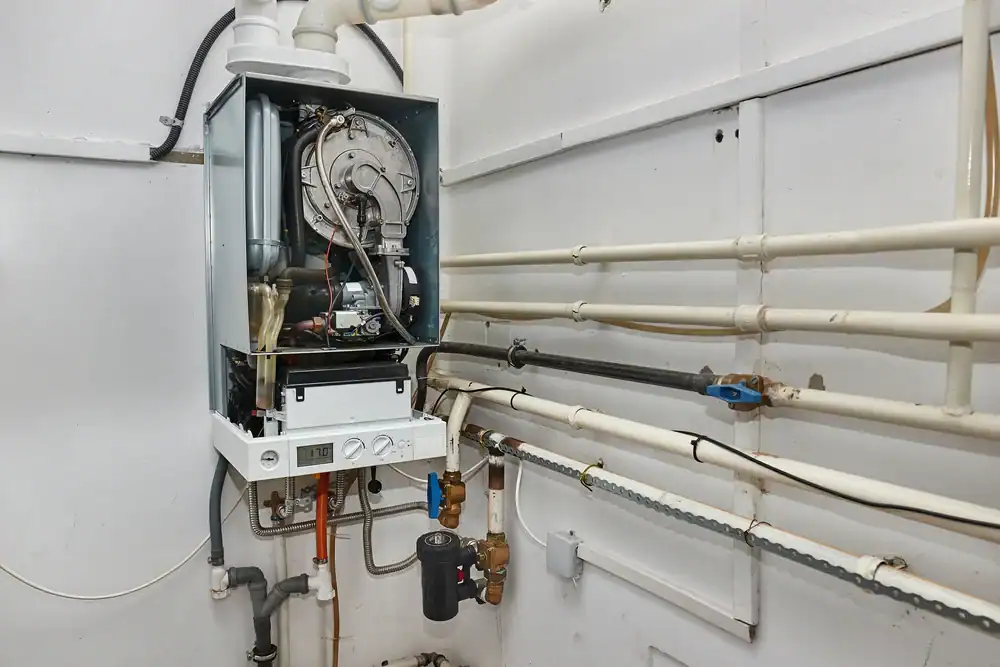
For homeowners in Essex County, NJ — particularly in older towns like Montclair, Glen Ridge, South Orange, and Maplewood — there’s an additional layer worth paying attention to. A significant portion of the housing stock in these communities was built in the early to mid-20th century, and many of those homes still run on steam boilers and cast-iron radiator systems. These aren’t your standard forced-air setups, and not every HVAC contractor is equipped to service them properly.
A good maintenance agreement for an older Essex County home should specifically include steam boiler checks — looking for leaks, verifying consistent radiator temperatures across floors, and maintaining combustion efficiency. If a plan doesn’t address that, it’s not fully covering your system.
Beyond the technical work, a solid agreement also gives you documented proof that your system has been professionally serviced. That documentation matters more than most homeowners realize. Every major HVAC manufacturer — Trane, Lennox, Weil-McLain, American Standard, Daikin — requires proof of routine professional maintenance to keep your warranty valid. If your system fails and you haven’t kept up with documented service visits, the manufacturer can deny the claim. For anyone with a newer system, that’s a real financial exposure, not a hypothetical one.
The other thing a good agreement gives you is a relationship with a contractor before you’re in crisis mode. When your heat goes out at 11 PM in February, you don’t want to be calling strangers and hoping someone picks up. You want to call someone who already knows your system, has been to your house before, and has you on their priority list.
How Often Should HVAC Maintenance Be Done?
The Department of Energy recommends at minimum semi-annual professional maintenance — once before the cooling season and once before the heating season. That frequency isn’t arbitrary. HVAC systems work hardest at the extremes of the year, and the wear that accumulates over a full season of operation is exactly what a pre-season tune-up is designed to address before it compounds into something more serious.
For Essex County, NJ homeowners, the semi-annual schedule maps directly onto the local climate reality. Redfin data shows that 56% of homes in Essex County carry a Severe Heat Factor rating, and the county is projected to see a 114% increase in the number of days over 100°F over the next 30 years. That’s not a distant concern — it’s already affecting how hard cooling systems have to work.
At the same time, New Jersey winters are no easier on heating systems. Furnaces and boilers that haven’t been serviced since the previous spring are running hard in January cold snaps, and that’s when failures happen. The practical answer to “how often” is this: twice a year, timed to the seasons. Once in spring to prep your AC before the heat arrives, and once in fall to prep your heating system before the cold sets in.
Anything less often than that and you’re running your system into the most demanding months of the year without knowing what condition it’s in. For older systems or older homes — which describe a lot of the housing stock across Essex County — staying on that schedule is especially important because smaller issues compound faster when the equipment is already working against age and wear.
Is HVAC Maintenance Worth It?
This is the question most homeowners are actually asking when they start researching maintenance agreements. The honest answer is that the math almost always favors the plan — but only if you’re comparing it honestly against the full range of what can go wrong without one.
A maintenance plan typically runs between $150 and $300 per year. A failed compressor replacement runs between $1,200 and $4,000. A full system replacement can run significantly higher. The EPA’s preventive maintenance guidance estimates that for every dollar spent on maintenance, homeowners save four dollars in avoided repair costs. That’s a 400% return, and it doesn’t account for the energy savings on top of it.
The Real Cost of Skipping Annual HVAC Maintenance
Skipping maintenance doesn’t mean nothing happens. It means the small things that would have been caught during a routine visit quietly get worse. A slightly dirty coil becomes a severely fouled one. A minor refrigerant issue becomes a compressor under sustained stress. An aging belt or loose electrical connection becomes a failure mid-season.
The U.S. Department of Energy has documented that a neglected HVAC system can use up to 25% more energy than one that receives regular service. On a meaningful monthly energy bill, that adds up to hundreds of dollars per year in waste — often more than the cost of the maintenance plan itself.
The American Society of Heating, Refrigerating, and Air-Conditioning Engineers (ASHRAE) puts the breakdown risk reduction from regular maintenance at up to 95%. That’s not a marketing number — it’s the result of systematic research into what happens to mechanical systems when they’re maintained versus when they’re not.
There’s also the lifespan question. Properly maintained HVAC systems last five to seven years longer on average than neglected ones. In a county where the median home sale price is around $720,000, the HVAC system is a meaningful component of the home’s value and its marketability. Buyers notice when systems are well-documented and well-maintained — and they notice when they’re not.
The “pay as you go” argument — just call when something breaks — sounds reasonable until you’re the one calling in January with no heat and a two-day wait for a technician. Emergency repairs during peak season cost more, take longer, and often reveal problems that routine maintenance would have caught months earlier.
What to Look for in an HVAC Maintenance Plan in Essex County, NJ
Not all maintenance agreements are built the same, and the differences matter. Here’s what to actually look for when you’re comparing options in Essex County, NJ.
Start with what’s explicitly covered at each visit. A vague agreement that says “inspection and tune-up” without specifying what that means gives the contractor a lot of room to do very little. You want to know what systems are being checked, what components are being cleaned or adjusted, and what documentation you’ll receive afterward. That documentation isn’t just paperwork — it’s your proof of maintenance for warranty purposes.
Look at the priority service language. During peak season, HVAC companies in Northern New Jersey are stretched thin. If a plan doesn’t explicitly guarantee priority scheduling for agreement customers, the benefit of “emergency access” may be more theoretical than real. Understand what “priority” actually means in practice before you sign.
Ask whether the agreement covers steam boiler systems if your home has one. Many homes in Montclair, Glen Ridge, and the surrounding Essex County towns were built before forced-air heating was standard. If the contractor isn’t experienced with steam systems specifically — checking for leaks, balancing radiator temperatures, maintaining combustion efficiency — they may not be the right fit for your home regardless of how attractive the plan looks on paper.
Finally, look at flexibility. Can the agreement be transferred if you sell your home? What happens if you want to cancel? A good plan should be straightforward on both counts. Hidden fees, automatic renewals with no notice, or contracts that don’t transfer are red flags worth taking seriously.
What you’re ultimately looking for is a contractor who knows your system, shows up when they say they will, tells you the truth about what they find, and doesn’t manufacture problems to justify additional work. A contractor with a genuine reputation in the community — one who’s been doing this work in Essex County for decades — is a much lower risk on that front than a company you’ve never heard of.
Finding the Right HVAC Maintenance Agreement for Your Home
An HVAC maintenance agreement is worth it when the contractor behind it is worth trusting. The plan itself is only as good as the technician who shows up, the thoroughness of the work they do, and the honesty they bring to what they find. For Essex County, NJ homeowners — especially those in older homes with aging heating systems — the right agreement isn’t just a convenience. It’s a way to protect a system that’s already working hard against the demands of the local climate and the age of the equipment.
The numbers are on the side of regular maintenance. The warranty protection argument is real. The priority service benefit is real. And the peace of mind that comes from knowing your system has been checked by someone who actually knows it — before January or July makes the stakes painfully obvious — is worth more than most people give it credit for.
If you’re ready to talk through what a maintenance agreement would look like for your specific home and system, we’ve been doing exactly this work in Essex County, NJ since 1973. Reach out and we’ll give you a straight answer.
Article details:
- Published by:
- Adriatic Aire LLC
- Published to:
- Last modified:
- September 10, 2026
Share:
Continue learning: