Boiler Installation Cost: 2026 Investment Guide
Share:
Your boiler’s been making that noise again. Or maybe your energy bills have crept up so high you’re wondering if something’s wrong. Either way, you’re here because you need to know what a new boiler actually costs—and you want the real answer, not a sales pitch.
Boiler installation costs in Essex County typically range from $3,500 to $12,000, but that wide range doesn’t tell you much. What you really need is a breakdown of where that money goes, what choices you actually control, and how to avoid overpaying for equipment that doesn’t fit your home. Let’s walk through the numbers that matter.
What Goes Into Boiler Installation Cost
When contractors quote boiler installation, they’re bundling several distinct expenses. Equipment makes up 40-60% of your total cost. That’s the boiler itself—the metal box that heats your home. Labor accounts for most of the rest, typically $1,200 to $3,200 depending on how complex the job is.
Then there are the smaller pieces that add up. Permits run $50 to $300 in most New Jersey municipalities. Removing and disposing of your old boiler costs another $200 to $500. If your new system needs different venting, new piping, or upgrades to your gas line, those expenses stack on top.
The final number depends heavily on whether you’re doing a straightforward swap—same fuel type, same location, similar size—or making changes that require additional work. A like-for-like replacement is always the most affordable path. Switching from oil to gas, relocating the unit, or upgrading to a high-efficiency condensing system all push costs higher.
Equipment Costs: What You’re Actually Buying
Boiler units alone cost anywhere from $1,400 to $6,500 before installation. That range reflects differences in fuel type, efficiency rating, brand, and heating capacity. A basic 80% AFUE gas boiler for a smaller home might cost $2,000. A high-efficiency condensing model rated at 95% AFUE for a larger house could run $5,000 or more.
Efficiency matters because it directly affects your monthly bills. AFUE—Annual Fuel Utilization Efficiency—tells you how much of the fuel your boiler burns actually turns into heat for your home. An 80% AFUE boiler wastes 20% of its fuel up the chimney. A 95% AFUE condensing boiler wastes only 5%. Over a 15-year lifespan, that difference can save you thousands of dollars, especially if you heat with oil or propane.
But efficiency isn’t the only factor. Fuel type plays a huge role in both equipment cost and long-term operating expenses. Natural gas boilers are the most common in Essex County and typically cost $1,400 to $5,600 for the unit. They’re affordable to run where gas service is available. Oil boilers cost $1,700 to $6,500 and are popular in older homes without gas lines, but oil prices fluctuate and can spike during winter. Electric boilers are the least expensive to purchase—$1,000 to $6,000—but electricity costs more per BTU than gas, making them pricier to operate unless you’re in a very small space.
Sizing is another cost driver. Boilers are rated by BTU output—how much heat they can produce per hour. A 2,000-square-foot home in New Jersey typically needs 60,000 to 100,000 BTU depending on insulation, window quality, and how cold it gets. Contractors should perform a heat loss calculation to determine the right size. Oversized boilers cost more upfront and waste fuel by cycling on and off constantly. Undersized boilers run nonstop and still can’t keep up on the coldest days.
Brand names like Weil-McLain, Utica, Lennox, and Trane carry different price tags, but what you’re really paying for is build quality, warranty coverage, and parts availability. A reputable contractor can guide you toward brands that balance cost with reliability for your specific situation.
Labor and Installation: Where the Hours Go
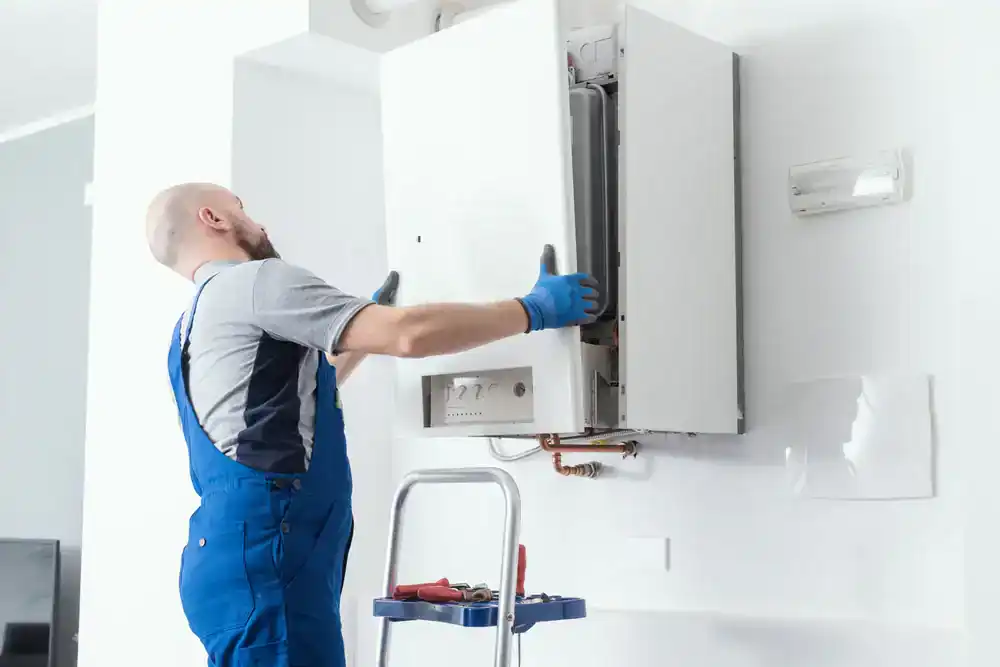
Labor typically runs $1,200 to $3,200 and accounts for 30-50% of your total project cost. That might sound high until you consider what’s involved. Your contractor has to disconnect and remove the old boiler—sometimes a 400-600 pound cast iron unit in a tight basement. They need to install the new unit, connect it to your existing piping, wire the electrical components, set up venting, test for leaks, and run the system through startup to make sure everything works correctly.
A straightforward replacement in an accessible location might take 4-6 hours. More complex jobs—fuel conversions, venting changes, or difficult access—can stretch into multiple days. Hourly rates for licensed HVAC technicians in New Jersey typically run $75 to $150 per hour, and most jobs require at least two people.
Location matters too. Labor costs in densely populated areas like Montclair or Clifton can run higher than in more rural parts of Essex County. Contractors factor in travel time, parking challenges, and local permitting requirements when pricing jobs.
The type of boiler you’re installing also affects labor costs. Standard efficiency boilers are simpler to install. High-efficiency condensing boilers require additional work—they need condensate drains, specific venting materials rated for lower temperatures, and careful setup to achieve their rated efficiency. Combi boilers that provide both heat and domestic hot water need integration with your plumbing system, adding complexity.
If you’re converting fuel types, expect labor costs to climb. Switching from oil to natural gas means running new gas lines, installing a gas meter if you don’t have one, removing the old oil tank, and potentially adding a chimney liner for proper venting. That can add $2,000 or more to the project. Moving your boiler to a new location—maybe to free up basement space—requires new piping runs and possibly electrical work, pushing costs higher.
Permits and inspections add time too. Your contractor needs to pull permits before starting work, and in many New Jersey towns, an inspector has to sign off on the installation before you can use the system. Responsible contractors build this time into their quotes. If someone offers to skip permits to save money, that’s a red flag—unpermitted work can cause problems when you sell your home and leaves you without recourse if something goes wrong.
New Boiler Selection: Fuel Types and Efficiency
Choosing a new boiler means deciding on fuel type and efficiency level. These two factors shape both your upfront investment and your monthly heating costs for the next 15-20 years. There’s no universal “best” choice—what works depends on your home’s infrastructure, your budget, and how you weigh initial cost against long-term savings.
Natural gas is the most popular option where service is available. Gas boilers offer a good balance of efficiency and operating cost. High-efficiency gas models with 90-95% AFUE ratings can save 10-20% on fuel bills compared to older 80% efficiency units. If you already have gas service, installation is straightforward. If you don’t, adding a gas line can cost $2,000 or more depending on distance from the street.
Oil boilers remain common in Essex County, especially in older neighborhoods without gas infrastructure. Oil burns hotter than gas, providing cozy warmth even on the coldest nights. But oil prices swing with global markets, and delivery logistics mean you need tank space and scheduled fill-ups. Modern oil boilers achieve 80-87% AFUE. High-efficiency oil models reach 90%+ but cost significantly more upfront.
Electric Combi Boiler Options for Homes Without Gas
Electric combi boilers are gaining attention as an alternative for homes without gas access or homeowners looking to move away from fossil fuels. These units provide both space heating and domestic hot water in one compact package, using electricity instead of combustion. They’re nearly 100% efficient at the point of use—almost all the electricity consumed turns into heat—but electricity costs more per BTU than natural gas in most of New Jersey, making them more expensive to operate.
Electric combi boilers shine in specific situations. If you live in a smaller home or apartment where space is tight, they’re compact and don’t require venting or chimney work. Installation is simpler than gas or oil systems, which can reduce labor costs. They’re also quiet, produce no combustion byproducts, and eliminate the risk of carbon monoxide leaks.
The catch is capacity. Electric combis work well for homes with modest heating loads and moderate hot water demand—think one or two bathrooms, not a large family home with simultaneous showers. They require a dedicated electrical circuit, and your electrical panel needs adequate capacity. If your panel is already maxed out, you might need an upgrade before installing an electric boiler, adding to the cost.
Operating costs depend heavily on your electric rates. Some homeowners pair electric boilers with time-of-use electricity plans, running the system during off-peak hours when rates are lower. Others combine them with solar panels to offset electricity costs. Without those strategies, monthly bills can exceed what you’d pay with natural gas, even though the boiler itself is more efficient.
Electric combis make the most sense when gas isn’t available, oil delivery is impractical, and you’re willing to manage operating costs through rate optimization or renewable energy. They’re not the cheapest option to run, but they offer simplicity, safety, and a path away from fossil fuel dependence if that aligns with your priorities.
High-Efficiency vs. Standard: When the Upgrade Pays Off
The efficiency question comes down to math and climate. High-efficiency condensing boilers cost $1,500 to $3,000 more than standard models, but they can cut fuel consumption by 15-30% depending on what you’re replacing. In a cold climate like New Jersey where your boiler runs hard from November through March, those savings add up faster.
Condensing boilers achieve 90-98% AFUE by extracting heat from exhaust gases that standard boilers vent outside. They cool those gases so much that water vapor condenses—hence the name—and that condensate needs to drain somewhere. You’ll need a condensate pump or drain line, and the venting materials must be rated for the lower temperatures and acidic condensate. Installation is more involved, which is why labor costs run higher.
Standard efficiency boilers—typically 80-85% AFUE—are simpler and less expensive. They vent through traditional chimneys or flues, don’t need condensate drains, and installation is straightforward. For homes with lower heating loads or homeowners planning to move within a few years, the lower upfront cost can make more sense.
The payback period matters. If a high-efficiency boiler costs $3,000 more but saves $400 per year on fuel, you break even in 7-8 years. Over a 15-year lifespan, you come out ahead. But if you’re only saving $200 per year, payback stretches to 15 years—right at the edge of the equipment’s expected life. A contractor who knows your home’s heat loss, your current fuel costs, and your usage patterns can run those numbers with you.
Efficiency also affects comfort. High-efficiency boilers often include modulating burners that adjust output to match demand, providing steadier heat and fewer temperature swings. Standard boilers typically run at one fixed output, cycling on and off more frequently. That’s not necessarily a problem, but some homeowners notice the difference.
One more consideration: rebates and incentives. While the federal tax credit for high-efficiency boilers expired at the end of 2025, many New Jersey utilities still offer rebates for ENERGY STAR equipment. Those rebates—typically $200 to $1,000—can narrow the price gap between standard and high-efficiency models, improving the payback math. Check with your utility company or ask your contractor about available programs before making a final decision.
Making Your Boiler Investment Decision
Boiler installation isn’t cheap, but it’s one of those investments that affects your daily comfort and monthly bills for years. The key is understanding what you’re paying for and making choices that fit your home, your budget, and your timeline. Equipment quality matters. Proper sizing matters. And working with a contractor who takes the time to assess your situation honestly—rather than pushing the most expensive option—matters most of all.
If you’re in Essex County and facing a boiler replacement, you don’t have to figure it out alone. We’ve been helping homeowners make these decisions since 1973. We’ll walk you through your options, explain the tradeoffs, and give you a straight answer about what makes sense for your home. No pressure, no upselling—just the information you need to move forward with confidence.
Article details:
- Published by:
- Adriatic Aire LLC
- Published to:
- Last modified:
- June 23, 2026
Share:
Continue learning: