AC Repair vs. Replacement: Use the $5,000 Rule to Decide
Share:
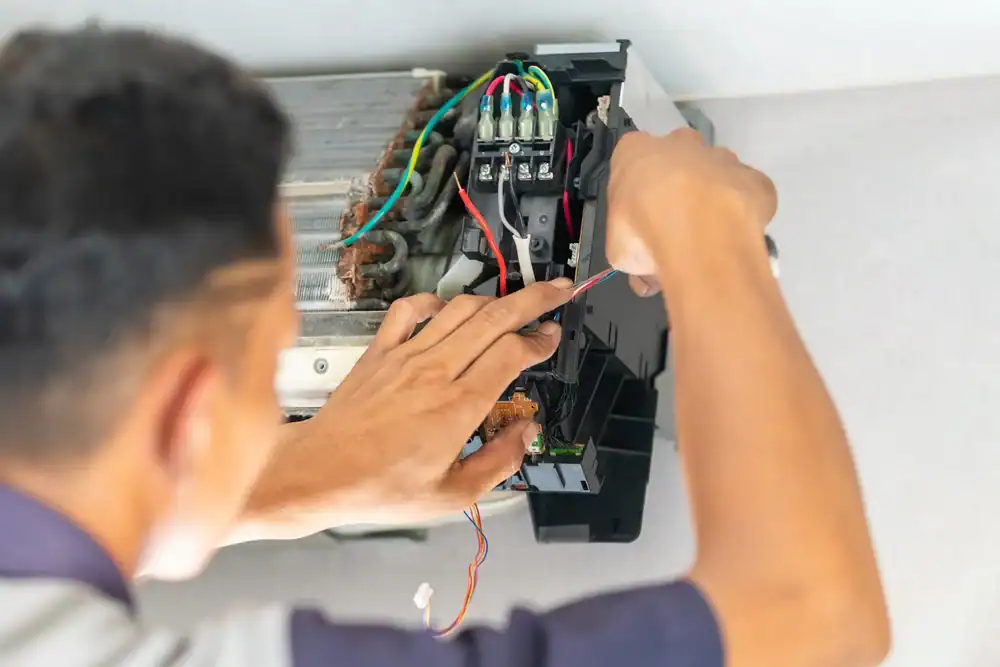
A technician just told you that you need a new system. Maybe you half-expected it. Maybe it came out of nowhere. Either way, you’re now standing in your home trying to figure out whether that recommendation is honest — or whether you’re being steered toward a sale. We built this guide to give you a real decision framework so you can evaluate the situation yourself, ask better questions, and feel confident in whatever you decide. No pressure, no pitch — just the information you actually need.
Should I Repair or Replace My AC? Start With This Calculation
The most useful tool for this decision is something HVAC professionals call the $5,000 Rule. It’s not complicated. Take the estimated cost of the repair and multiply it by the age of your system in years. If that number exceeds $5,000, replacement is generally the smarter financial move. If it’s under $5,000, repair may still make sense.
A $400 repair on a 10-year-old system gives you $4,000 — probably worth fixing. That same $400 repair on a 15-year-old system gives you $6,000 — and now the math is pointing somewhere else entirely. The repair cost didn’t change. The age did. That’s the whole point of the rule: it forces you to think about both variables together, not just the invoice in front of you.
How Long Do AC Units Last — and Why Age Changes Everything
The U.S. Department of Energy recommends that homeowners start consulting an HVAC technician about replacement once a central air conditioner is over 10 years old. Most systems are designed to last between 10 and 15 years, with well-maintained units occasionally pushing toward 20.
Once you’re past that range, you’re not just paying for a repair — you’re paying to extend the life of a system that’s already living on borrowed time. A system that “was working fine until last week” isn’t necessarily a system in good condition. Older AC units tend to lose efficiency gradually, running longer cycles and pulling more electricity to cool the same space.
You may not notice it on any single bill, but over two or three summers, it adds up. Replacing a system running at a 10 SEER rating — common on units installed in the early 2000s — with a modern 16 SEER2 unit can reduce your cooling energy costs by 30 to 50 percent annually. At New Jersey’s current electricity rates of $0.20 to $0.25 per kilowatt-hour, that’s a real number, not a marketing estimate.
Age also changes the risk profile of any repair. On a 7-year-old system, a capacitor replacement is a reasonable fix with years of reliable service still ahead. On a 14-year-old system, that same repair may hold for a season — or it may be the first in a series of failures as other aging components start to go. The $5,000 Rule captures this by weighting the repair cost against the system’s age.
For Essex County homeowners, this matters especially. Many homes in Montclair, Bloomfield, Glen Ridge, and West Orange are older Dutch Colonials and Victorians where central air was added retrofit-style — often in the early 2000s. If that’s your home, your AC system may be right at or past the 15-year mark, and the age variable in the $5,000 Rule deserves serious attention.
When to Replace Your AC Unit: The Factors That Override the Formula
The $5,000 Rule is a starting point, not a verdict. There are situations where the formula gives you a number under $5,000 but replacement is still the right call.
Refrigerant type is one of the biggest. If your system was installed before 2010, there’s a meaningful chance it uses R-22 refrigerant, commonly known as Freon. The EPA banned R-22 from new production effective January 1, 2020, which means the only supply left comes from recycled or stockpiled reserves. That makes it increasingly scarce and expensive.
A refrigerant leak on an R-22 system isn’t just a repair — it’s a decision point, because you’re paying a premium for a substance that’s harder to find every year, in a system that’s already at minimum 16 years old. In most cases, that math points firmly toward replacement regardless of what the $5,000 Rule says.
Compressor failure is another override. Replacing a compressor typically costs $1,500 to $2,500 or more. On a 12-year-old system, that’s a score of $18,000 to $30,000 on the $5,000 Rule scale — well past any threshold. But there’s a practical concern beyond the formula: compressor failure is often caused by secondary issues that don’t surface until after the compressor is replaced. You could pay for a new compressor and still have problems. That’s not a risk worth taking on an aging system.
Repair frequency matters too. If you’ve had two or three service calls in the past couple of years — each one individually manageable — that pattern is telling you something. No single repair looked alarming, but together they signal a system that’s degrading across multiple components at once.
Finally, consider whether your current system is actually keeping up. If certain rooms in your home are consistently warmer than others, if humidity feels off, or if your system is running almost constantly during a hot stretch, those are comfort symptoms of a system that’s no longer doing its job well — even when it’s technically “working.”
How to Know You’re Getting an Honest AC Repair or Replace Recommendation
The $5,000 Rule gives you a framework. But you still need a technician you can trust to give you accurate inputs — the real repair cost, an honest assessment of the system’s condition, and a straight answer about what they’d recommend if it were their own home.
That’s not a given. A contractor who sells and installs new systems has a financial interest in replacement. That doesn’t mean every replacement recommendation is self-serving, but it does mean you’re entitled to ask questions and expect clear answers. We walk our customers through the calculation, explain what other components are likely to fail, and tell them honestly whether a repair is likely to hold for another five years or whether it’s a short-term fix on a system with more problems coming.
What Essex County Homeowners Should Know Before Calling a Contractor
New Jersey has specific licensing requirements for HVAC contractors that are worth understanding before you let anyone open your system. Any contractor performing HVAC work in NJ must hold a state HVACR Contractor License issued by the NJ Division of Consumer Affairs. All AC replacements also require a permit — and only a licensed contractor can pull one.
An unlicensed contractor who skips the permit to save money can void your homeowner’s insurance coverage for HVAC-related claims and create liability when you go to sell the property. The permit isn’t a formality. It’s protection for you.
We hold NJ HVACR Contractor License No. 19HC00022600, and we invite you to verify it directly through the NJ Division of Consumer Affairs. We also carry a separate Home Improvement Contractor registration. Both are publicly searchable.
Beyond licensing, ask any contractor whether they’ll perform a load calculation before sizing a replacement system. Matching the old unit’s tonnage isn’t good enough. An oversized system short-cycles, which means it cools the air quickly but doesn’t run long enough to pull humidity out — a real problem during New Jersey summers. An undersized system runs constantly and still can’t keep up.
A proper Manual J calculation accounts for your home’s square footage, insulation, window placement, and orientation, and it’s the only way to know you’re getting the right system for your specific house. If you’re in an older home in Maplewood, South Orange, or elsewhere in Essex County, ductwork condition is another variable worth raising. Many mid-century homes in the area have duct configurations that were never designed for modern central air. A replacement system installed without addressing leaky or undersized ductwork will underperform from day one.
NJ Rebates and Tax Credits That Change the Replacement Math
One of the most common reasons homeowners lean toward repair when replacement is the smarter call is sticker shock. A new central AC system in New Jersey typically runs between $5,200 and $12,000 depending on the size of the home, the efficiency rating of the equipment, and whether ductwork needs to be addressed.
What most homeowners don’t know until a contractor tells them is that there are programs specifically designed to reduce that cost. PSE&G — the utility that serves Essex County — offers an HVAC Instant Rebates Program for qualifying high-efficiency equipment. The rebate is applied at the point of sale through participating contractors, which means you don’t have to file anything or wait for a check. The program is available through June 30, 2027.
On top of that, federal tax credits currently allow homeowners to claim 30 percent of the cost of qualifying central AC equipment, up to $600. These two incentives can be stacked, and when you factor in the monthly energy savings from replacing an old 10 SEER system with a modern 16 SEER2 unit, the effective cost of replacement over a three-to-five year window looks very different than the sticker price suggests.
PSE&G also offers a Whole House Incentive Program that includes up to $6,000 in rebates and up to $25,000 in zero-percent interest on-bill financing for qualifying projects. We also offer financing through FTL Finance for homeowners who want to spread the investment over time. The point is to make sure that if replacement is the right call, you’re not making the decision without knowing what resources are actually available to you.
Getting a Second Opinion You Can Trust in Essex County, NJ
The $5,000 Rule won’t make the decision for you, but it will keep you from making it blind. Run the numbers before any technician arrives. Know your system’s age — it’s usually on a sticker on the outdoor unit or the air handler. Get the repair estimate in writing. Do the math. Then have a conversation with someone who will give you a straight answer about whether the repair is likely to hold.
We’ve been doing this in Essex County since May 15, 1973 — over 50 years of repair-or-replace conversations with homeowners who deserved an honest answer, not a sales pitch. Our 500-plus Google reviews at a 5.0 rating reflect that commitment, and more than a few of them use the word “honest” without being prompted.
If you’re weighing this decision right now, we offer free estimates with no pressure and no obligation. Reach out to Adriatic Aire and let’s talk through what you’re actually dealing with.
Article details:
- Published by:
- Adriatic Aire LLC
- Published to:
- Last modified:
- September 17, 2026
Share:
Continue learning: