AC Refrigerant Recharge Costs in Essex County, NJ Explained
Share:
Your AC is running, but the house isn’t cooling down. You’ve checked the filter, the thermostat is set right, and still — warm air. A neighbor mentions refrigerant. You search the cost and find numbers ranging from $100 to $600, with no clear explanation of why.
That range isn’t random, and understanding it matters before you call anyone. This guide covers what an AC refrigerant recharge actually costs in Essex County, what drives the price up or down, and — just as importantly — what questions to ask so you don’t end up paying for a fix that doesn’t hold.
Freon Recharge Cost: What Essex County Homeowners Are Actually Paying
In Essex County, most residential AC refrigerant recharges run between $200 and $600. That range isn’t vague — it reflects a real difference in refrigerant type, system size, and whether a leak repair is included.
A straightforward R-410A recharge on a newer system tends to land closer to the lower end. An older system running on R-22 — the refrigerant that was phased out of production in 2020 — can push well past $400 just for the refrigerant itself.
Labor and the service call are separate line items on top of that. Leak detection, if needed, adds another $50 to $130. The total cost of a proper recharge — diagnosis, leak repair, refrigerant, and a post-service pressure test — can reach $600 or more for complex situations. That’s what comprehensive service costs when it’s done right.
AC Recharge Cost by Refrigerant Type: R-22 vs. R-410A vs. R-454B
The single biggest factor in what you’ll pay is the type of refrigerant your system uses. There are three you’re likely to encounter, and they’re not interchangeable.
**R-22 — often called Freon** — was the standard refrigerant for home AC systems built before roughly 2010. Production of R-22 ended in 2020 under EPA regulations, which means the remaining supply is finite and getting more expensive every year. In 2025, R-22 runs $100 to $250 per pound installed. A full recharge on an R-22 system can easily cost $350 to $600 or more, depending on how much refrigerant the system needs.
If you have an older Essex County home — say, a colonial in Livingston or a split-level in Nutley built in the 1990s — and the AC has never been replaced, there’s a real chance it’s still running on R-22. At current prices, a recharge on one of these systems is often the beginning of a serious repair-versus-replace conversation, not just a routine fix.
**R-410A** became the standard replacement for R-22 and was used in virtually all new residential equipment from around 2010 through 2024. It’s significantly less expensive than R-22 — roughly $40 to $90 per pound installed — which is why recharges on newer systems tend to cost less.
However, R-410A is now facing its own phase-out. As of January 1, 2025, manufacturers can no longer produce new residential AC equipment using R-410A. The refrigerant itself can still be used to service existing systems, but as stockpiles deplete, expect prices to climb. Industry projections suggest a recharge that cost $280 a couple of years ago could run $420 by 2026 and $600 or more by 2029.
If your system was installed between 2010 and 2024, it almost certainly uses R-410A — and this trajectory matters when you’re weighing whether to recharge again or start planning for a replacement.
**R-454B** is the new standard refrigerant for equipment manufactured in 2025 and beyond. If you’ve recently installed a new system, this is what it uses. Recharge costs for R-454B systems are still settling into the market, but current estimates put it around $80 per pound installed.
Technicians servicing R-454B systems need updated certifications and equipment because it’s classified as a mildly flammable refrigerant — something to keep in mind when vetting who you call.
Why Low Refrigerant Always Means There’s a Leak
This is the part most cost guides skip over, and it’s the most important thing to understand before you schedule a recharge. Refrigerant doesn’t get used up. It circulates in a sealed loop inside your AC system, and in a properly functioning system, the same refrigerant that was charged at installation is still there 10 or 15 years later.
If your refrigerant is low, something is wrong with the seal. There is a leak somewhere.
Topping off the refrigerant without finding and fixing that leak is like pouring water into a bucket with a hole in the bottom. You’ll be cooler for a while, and then you’ll be right back where you started — possibly within a season or two. Some homeowners go through this cycle multiple times before anyone tells them what’s actually happening. Each recharge costs money, and none of them solve the problem.
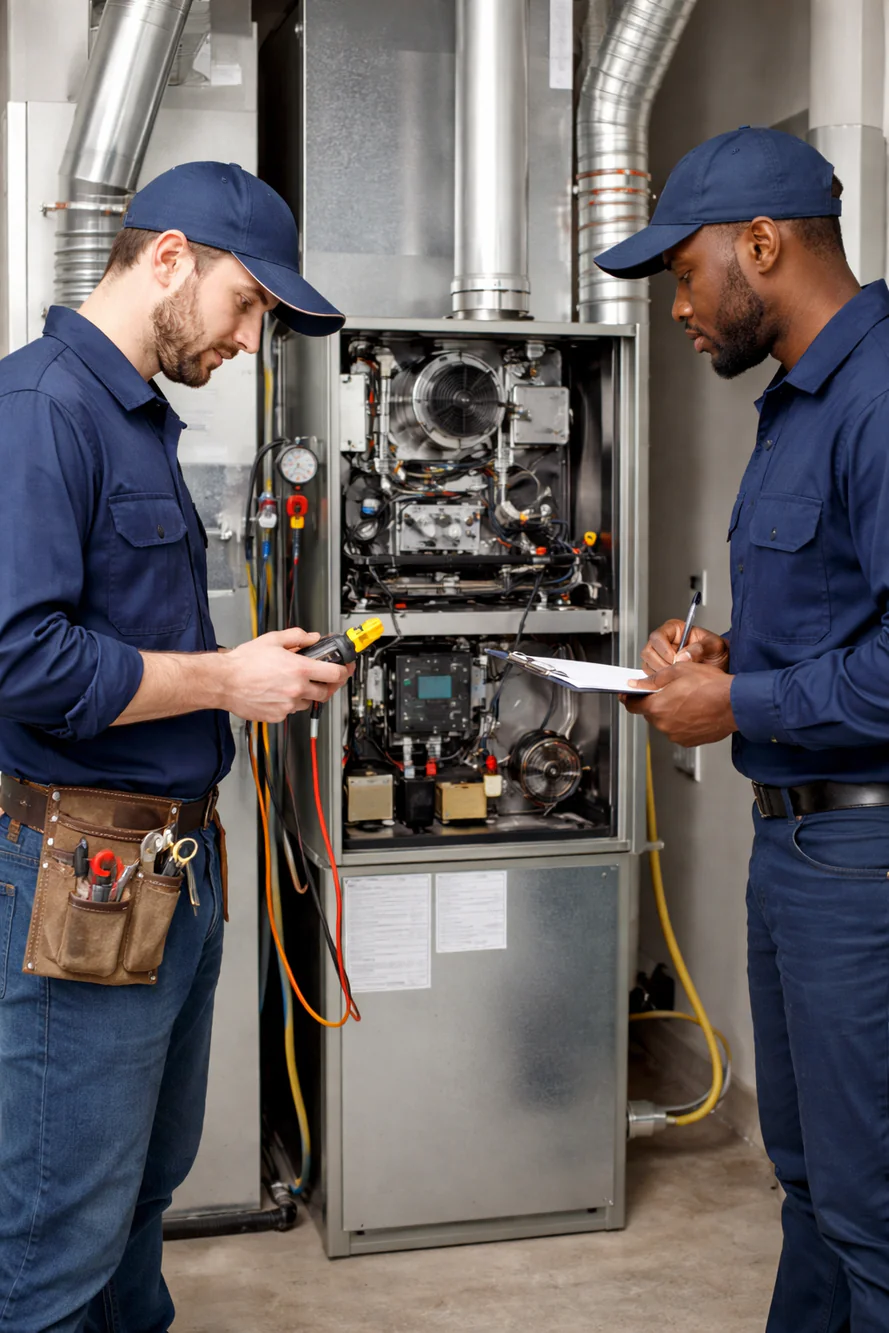
A proper refrigerant recharge service starts with a diagnosis. We check system pressure, inspect the coils, test electrical components, and look for the source of the refrigerant loss — either with an electronic leak detector, UV dye, or nitrogen pressure testing. Once the leak is found and repaired, then the refrigerant is added. Then the system is tested again to confirm it’s holding pressure and cooling properly.
That’s the sequence. Anything shorter than that is incomplete service, regardless of how low the price looks.
This is especially relevant in Essex County, where the combination of high summer humidity and sustained heat pushes AC systems hard. The Passaic River valley climate means your system isn’t just cooling — it’s dehumidifying constantly through July and August. That continuous load accelerates wear on refrigerant lines and connections over time.
A system that’s been running hard for ten summers in Montclair or South Orange has had more stress on it than the same system would in a drier climate. That context matters when you’re trying to understand why a leak developed in the first place.
Cost to Recharge AC: Is It Worth It for Your System?
Knowing the cost of a recharge is only part of the decision. The other part is whether the recharge makes financial sense given your system’s age, refrigerant type, and overall condition. That calculation looks different for a 5-year-old R-410A system than it does for a 15-year-old R-22 unit.
The honest answer is that a recharge is usually worth it when the system is relatively young, the leak is minor and repairable, and the refrigerant type isn’t already prohibitively expensive. When those conditions aren’t met, you may be spending $400 to $600 to buy yourself one more summer on a system that’s heading toward replacement regardless.
When a Refrigerant Recharge Makes Sense — and When It Doesn’t
For systems under 10 years old using R-410A, a recharge combined with a proper leak repair is usually a reasonable investment. The system has useful life remaining, R-410A is still serviceable, and the cost of repair is well below what a new system would run. If the leak is in an accessible location and the repair is straightforward, you’re looking at a fix that should hold for several more years.
The math gets harder for older systems. If your AC is 12 to 15 years old and running on R-22, a full recharge could cost $400 to $600 or more — and that’s before accounting for any other wear-related repairs the system might need. At that point, the question isn’t just “how much does the recharge cost?” It’s “how many more years of reliable cooling will this system give me, and what will those years cost compared to replacing it now?”
That’s a conversation worth having with a technician you trust to give you a straight answer, not one who defaults to whichever option generates more revenue.
There’s also the R-410A trajectory to factor in. If your system is a 2012 or 2015 installation — still running fine but showing the first signs of refrigerant loss — the recharge might cost $250 today and $400 in two years if prices continue climbing. That doesn’t automatically mean replacement is the right move, but it’s information that should be part of the decision.
One other scenario worth naming: if you’ve had your system recharged before and it’s low again within a year or two, that’s a red flag. Either the leak wasn’t properly repaired the first time, or a new leak has developed. Either way, repeating the same recharge without a thorough diagnostic is not a solution.
What to Expect from a Refrigerant Recharge Service in Essex County, NJ
A refrigerant recharge typically takes one to three hours for most residential systems. That includes the diagnostic, the leak detection and repair, adding the refrigerant, and testing the system before we leave. If the leak is complex or in a hard-to-reach location, it can take longer — and the repair cost will reflect that.
Before any work starts, you should receive a written estimate. That estimate should break out the service call, the labor, the refrigerant cost (including how many pounds are being added and at what rate), and any leak repair costs. If a technician gives you a single number with no breakdown, ask for the detail. You’re entitled to understand what you’re paying for.
One thing that matters in Essex County specifically: technicians handling refrigerant must hold EPA Section 608 certification. This is a federal requirement under the Clean Air Act, not a voluntary credential. It’s what allows a technician to legally purchase, handle, and install refrigerant for stationary HVAC equipment. Homeowners cannot legally buy or self-install refrigerant for central AC — this isn’t a company policy, it’s federal law.
When you’re vetting who to call, asking whether their technicians are EPA Section 608 certified is a reasonable and legitimate question.
State licensing matters too. In New Jersey, HVAC contractors are required to hold a state HVAC contractor license. We carry NJ HVAC License No. 19HC00022600 and NJ Home Improvement Contractor No. 13VH05686500 — both publicly verifiable through the NJ Division of Consumer Affairs. We’re also fully bonded and insured. These aren’t just checkboxes; they’re the baseline for work that’s done legally and with financial accountability behind it.
Essex County’s summer heat amplifies the urgency of getting this right. When July temperatures climb into the upper 80s and humidity makes it feel worse, a struggling AC system isn’t just uncomfortable — for elderly residents and young children, it can become a health concern. We offer same-day service and are available 24 hours a day, seven days a week, because heat waves don’t follow business hours. If your system goes down during a heat event in Montclair, Livingston, Newark, or anywhere else in Essex County, we can get there.
Getting an Honest AC Refrigerant Recharge Estimate in Essex County
The short version: an AC refrigerant recharge in Essex County costs between $200 and $600 for most residential systems, with the final number depending on your refrigerant type, how much is needed, and whether a leak repair is part of the job. R-22 systems cost more — sometimes significantly more. R-410A costs are rising as phase-out tightens supply. And any recharge done without addressing the underlying leak is a temporary fix, not a solution.
The right service starts with a diagnosis, includes a leak repair when needed, and ends with a tested, pressure-confirmed system — not just a top-off and a handshake. You should receive a written estimate before anyone starts work, and that estimate should be specific enough that you know exactly what you’re paying for.
Adriatic Aire has been doing this work in Essex County since 1973. We give you a straight answer on what’s wrong, what it costs, and whether the repair makes sense for your system’s age and condition. Free estimates, no surprise charges, and a workmanship guarantee on everything we do. If you’re ready to find out what’s going on with your system, give us a call.
Article details:
- Published by:
- Adriatic Aire LLC
- Published to:
- Last modified:
- September 15, 2026
Share:
Continue learning: