Older Homes and HVAC in Essex County, NJ: Why They’re Different
Share:
If you own an older home in Essex County — a Victorian in Glen Ridge, a Colonial in Maplewood, a pre-war brownstone in Montclair — you already know that most HVAC advice wasn’t written with your house in mind. The contractor who quotes you a central air system over the phone has probably never seen a one-pipe steam system or a cast-iron radiator. The articles you’ve read online assume you have ductwork. You don’t.
Your house is different, and it deserves a different conversation. Here’s what you actually need to know.
What Makes Old House HVAC So Much More Complicated
Homes built before 1940 weren’t designed with modern heating and cooling in mind. The walls are plaster over lath — not drywall. There are no mechanical chases, no duct runs, and often no insulation in the wall cavities. According to U.S. Energy Information Administration data, pre-1940 homes use roughly 40% more energy per square foot than homes built after 2000. That gap isn’t just about old equipment — it’s the structure itself.
In Essex County, this isn’t a fringe situation. In Montclair alone, about 56% of the housing stock was built before 1940, with a median construction year of 1938. Glen Ridge, Bloomfield, South Orange, and Maplewood tell a similar story. These are beautiful, well-maintained homes with real market value — Montclair’s median home value sits around $1.17 million — but they come with HVAC challenges that most contractors simply aren’t trained to handle.
The result is that homeowners throughout Essex County often get bad advice, incomplete quotes, or contractors who default to whatever they know best rather than what actually fits the house.
Steam Heat and Radiators: What’s Still Working and What Isn’t
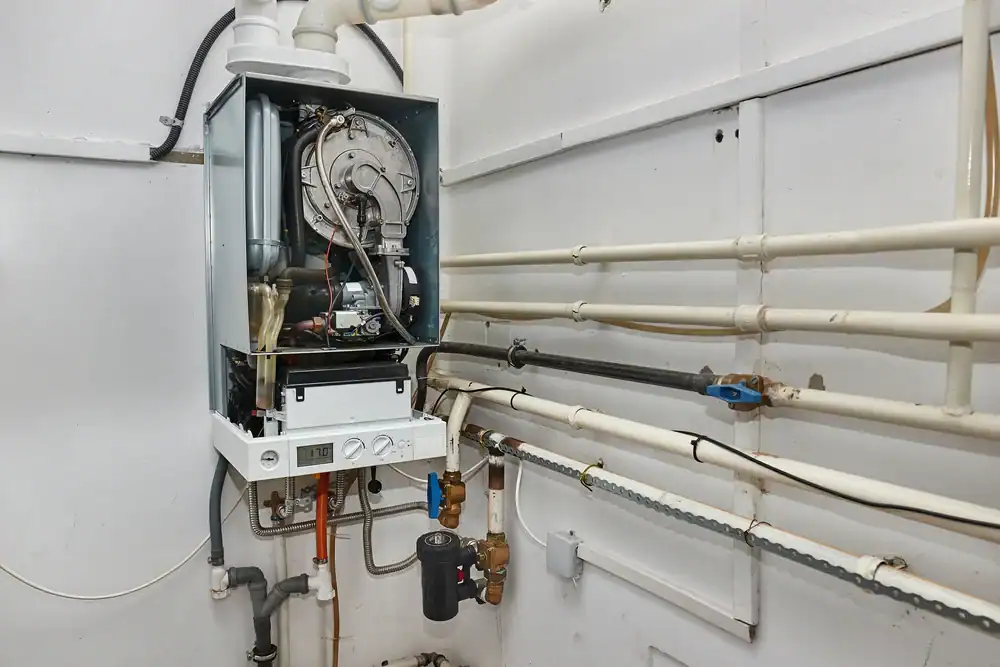
A lot of older homes in Essex County are still heated by steam boiler systems connected to cast-iron radiators. If that’s your house, you’ve probably heard conflicting things about whether to keep the system, replace it, or rip it out entirely. The honest answer is: the radiators themselves are usually fine.
Cast-iron radiators provide even, comfortable radiant heat that many homeowners actually prefer to forced-air systems. They don’t dry out the air, they don’t blow dust around, and they heat a room slowly and steadily. The problem isn’t the radiators — it’s usually the boiler behind them, or the fuel source feeding it.
Steam systems do have quirks. Banging pipes, uneven heat from room to room, and air venting issues are common complaints. These are real problems, but they’re also solvable ones — if the person diagnosing them actually understands how steam heat works. That’s not a given. Modern HVAC training is heavily focused on forced-air systems. Steam heat is a specialty, and fewer contractors know it well with each passing year.
One distinction worth understanding is the difference between a one-pipe and a two-pipe steam system. In a one-pipe system, steam travels out through the supply pipe and condensate returns through the same pipe — which limits your options if you’re thinking about converting to a different type of hydronic heat. Two-pipe systems are more flexible. Knowing which one you have matters before any contractor gives you a recommendation, and we always ask about it before quoting anything.
The bigger picture for most oil-heated steam homes in Essex County is this: the radiators can stay, but the boiler and fuel source are often the right place to start making changes.
Is It Worth Switching from Oil Heat to Gas in New Jersey?
If your older home runs on oil heat, you’ve probably felt the anxiety that comes with every delivery season. Oil prices swing with global markets, delivery schedules add friction, and the system itself — oil filter changes, nozzle replacements, annual cleanings — demands more ongoing maintenance than gas. For a lot of Essex County homeowners, the question isn’t really whether to convert. It’s whether now is the right time, and what it actually involves.
Here’s the efficiency case in plain terms. Older oil boilers typically operate somewhere between 56% and 80% AFUE — meaning up to 44 cents of every dollar you spend on fuel is lost. A modern high-efficiency gas boiler runs at 95% AFUE. That’s not a small difference. Converting from an outdated oil system to high-efficiency gas can deliver up to 39% more fuel efficiency, and natural gas rates in New Jersey are generally more stable and lower per delivered BTU than heating oil.
PSE&G, which serves most of Northern New Jersey, offers rebates of $300 to $600 on qualifying high-efficiency systems as part of their HVAC Instant Rebates Program. Most Essex County homeowners who make the switch recoup their investment within five to ten years through lower annual fuel costs — numbers we’ve seen play out consistently in the communities we serve.
The conversion process involves more than swapping out a boiler. PSE&G requires permits and a safety inspection, which means the work has to be done by a licensed contractor. That’s not a formality — it’s a safety requirement, especially in older homes where gas lines may be running near aging infrastructure. We hold New Jersey License No. 19HC00022600 and have handled oil-to-gas conversions throughout Essex County for decades. It’s one of the things we know how to do right, and it’s one of the most impactful upgrades an older-home owner can make.
We don’t offer oil heating repair as a standalone service. If your oil boiler needs work, our recommendation will always be to assess whether conversion makes more sense — and in most cases, it does.
Radiator Heating System but No Air Conditioning — Now What?
Here’s the problem that doesn’t get talked about enough. Steam and hot-water radiator systems are heating-only. They do nothing for cooling. So if your older Essex County home has a boiler and radiators, you’ve got heat covered — but come July, you’re either running window units in every room or sweating through it.
This is the gap that catches a lot of buyers off guard. You fall in love with a 1920s Colonial in South Orange, the steam heat works fine, and then your first summer arrives and you realize there’s no path to central air without a major renovation. It doesn’t have to be that way.
Can You Add Air Conditioning to an Old House Without Ductwork?
Yes — and the answer most people land on after doing their research is ductless mini-splits. The name sounds technical, but the concept is straightforward. A small outdoor compressor connects to one or more indoor units through a line set that requires roughly a three-inch hole in the wall. That’s it. No ductwork. No tearing into original plaster. No compromising the woodwork or period details that make these homes worth preserving in the first place.
Each indoor unit conditions the room or zone it’s in, independently. That means you can cool the bedrooms without running the living room unit, or heat a specific addition without affecting the rest of the house. For a two-story Victorian in Montclair where every room has different sun exposure and different needs, that kind of zone control is genuinely useful — not just a feature on a spec sheet.
The efficiency numbers are real, too. Modern inverter-driven mini-splits can achieve up to 400% efficiency in heating mode — meaning for every unit of electricity consumed, the system delivers four units of heat energy. They move heat rather than generate it, which is why the math works out that way. And despite the old reputation that heat pumps don’t perform in cold climates, today’s cold-climate mini-splits — including the Daikin models we install and service — maintain full heating capacity well below freezing. Northern New Jersey winters are not a problem for these systems.
For homes in Glen Ridge or Maplewood where historic preservation is a real concern, ductless mini-splits are often the only practical path to cooling that doesn’t require structural changes. Wall-mounted units work well in bedrooms and secondary spaces. Ceiling cassette units are a cleaner look for main living areas. The installation footprint is minimal, and the result is a home that’s comfortable year-round without sacrificing what makes it architecturally worth caring about.
How Do You Know Which HVAC System Is Right for Your Older Home?
This is the question that deserves a real answer instead of a generic one. The honest truth is that there’s no universal right answer — it depends on your existing system, your home’s layout, how you use the space, and what problem you’re actually trying to solve. A contractor who gives you a recommendation without walking through your house first is guessing, and guessing on a project like this is expensive.
New Jersey building code requires that new HVAC equipment be sized using ACCA Manual J load calculations — not rule-of-thumb estimates, not square footage multiplied by a number someone memorized. Oversized systems short-cycle and wear out faster. Undersized systems can’t keep up with a Northern New Jersey winter. Proper sizing matters, and it can only happen after a real assessment of the home.
For older homes in Essex County specifically, that assessment needs to cover a few things that wouldn’t come up in a newer house. What type of steam system do you have — one-pipe or two-pipe? What condition are the existing radiators in? Is the electrical panel capable of supporting a mini-split or heat pump system, or does it need an upgrade first? Is there a natural gas line at the street, and what’s the conversion path if you’re currently on oil? These aren’t complicated questions, but they’re the right ones — and a contractor who doesn’t ask them probably isn’t the right fit for your home.
We’ve been doing this work in Essex County since 1973. Not as a franchise, not as a private equity rollup — as a family business, based in Montclair, serving the same communities for over fifty years. The homes we work on today are often the same homes we’ve been servicing for decades. That kind of continuity matters when you’re making a decision that’s going to affect how your house performs for the next twenty years. We service Weil-McLain and Utica boilers — the two brands most commonly found in older New Jersey homes — and we’ve handled enough steam systems, oil conversions, and ductless installations in Essex County to know what actually works and what doesn’t.
Finding the Right HVAC Help for an Older Home in Essex County, NJ
Older homes in Essex County are worth taking seriously — and so are the decisions you make about how to heat and cool them. The wrong system, or the wrong contractor, can mean years of discomfort, wasted money, or damage to a home that took decades to build right the first time.
The good news is that the options are genuinely better than they used to be. Oil-to-gas conversion makes financial sense for most Essex County homeowners still running on oil. Ductless mini-splits solve the cooling problem without touching the walls. And steam systems, maintained or modernized properly, can keep working well for another generation.
If you’re not sure where to start, a free in-home assessment is the lowest-risk way to get clarity. We offer free estimates on every project — no pressure, no guesswork, just a straight conversation about what your home actually needs.
Article details:
- Published by:
- Adriatic Aire LLC
- Published to:
- Last modified:
- August 11, 2026
Share:
Continue learning: