Fall Boiler Maintenance: Pre-Winter Checklist for Essex County, NJ
Share:

If your house has radiators, you already know the drill. The first cold week of October arrives, you flip on the heat, and you hold your breath. Maybe it fires right up. Maybe it doesn’t. Most homeowners in Montclair, Glen Ridge, Maplewood, and across Essex County with older boiler systems have been through at least one version of that moment — and the ones who haven’t are usually the ones who schedule a fall tune-up before it gets to that point. We’ve been helping Essex County families avoid that panic since 1973. This guide covers what boiler maintenance actually involves, what you can do yourself, and what needs a licensed technician. By the end, you’ll know exactly what to do — and when.
What Does Boiler Maintenance Actually Include?
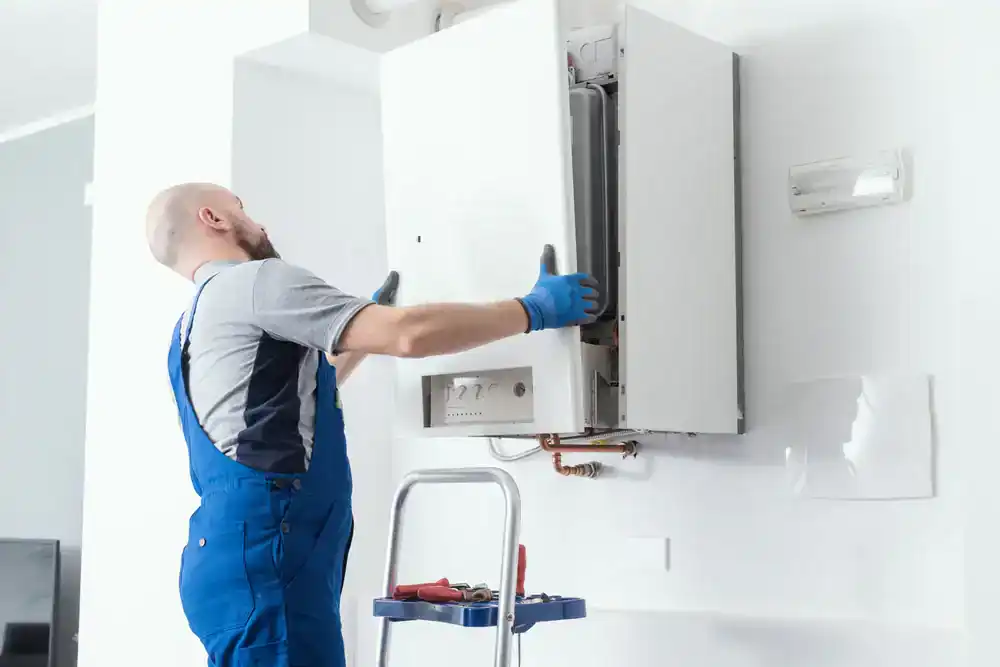
A lot of homeowners picture boiler maintenance as someone coming out, glancing at the unit, and handing over an invoice. That’s not what a real tune-up looks like. A thorough annual service visit covers a specific set of inspections and tests that you simply cannot perform without professional tools — and skipping them isn’t just an inconvenience, it’s a safety risk.
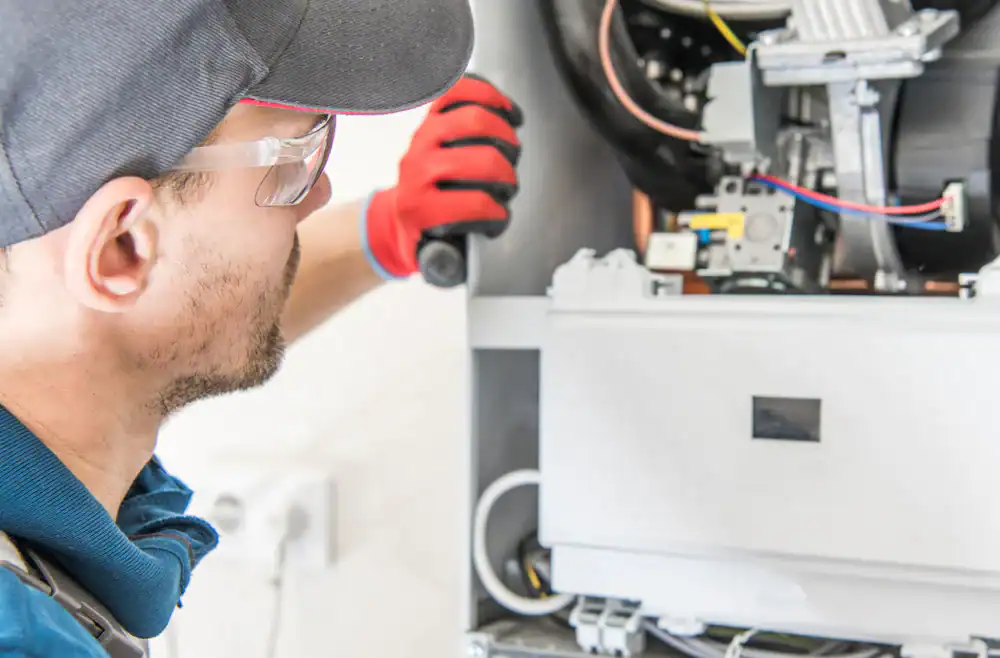
The visit should include a combustion analysis, heat exchanger inspection, flue and venting check, pressure gauge reading, pressure relief valve test, circulator pump inspection, zone valve check, and a carbon monoxide test. For steam boiler systems — which are common throughout Montclair, Glen Ridge, and Maplewood — we also check steam traps and water levels. For hot water systems, we look at the expansion tank and bleed the system if needed.
What you can do on your own is limited but useful. Check your pressure gauge — a residential hot water boiler should read between 12 and 15 PSI when cold. Test your emergency shutoff. Replace thermostat batteries. Beyond that, leave it to someone licensed to do the work.
Why the Heat Exchanger and Flue Check Matter More Than People Think
Of everything we inspect during a boiler maintenance visit, the heat exchanger and venting system are the two that carry the most serious consequences if missed. A cracked heat exchanger can allow carbon monoxide to migrate into your living space. CO is colorless, odorless, and doesn’t give you any warning before it becomes dangerous. The only way to know whether your heat exchanger is intact is a professional inspection. No homeowner checklist covers this.
Flue and venting issues are similarly invisible. A blocked or deteriorating flue means combustion gases that should be exiting the house are staying in it. In older homes — and Essex County has no shortage of them — venting systems may have been patched, rerouted, or simply aged past their useful life without anyone noticing.
This is particularly relevant if your home was built before 1960. A significant portion of the housing stock in towns like Caldwell, Bloomfield, Belleville, and South Orange dates back to that era or earlier. Boilers in those homes may have been replaced once or twice since the house was built, but the venting infrastructure often hasn’t kept pace. A technician who knows what to look for in these older systems is worth a lot more than one running through a generic checklist.
Most boiler manufacturers require documented annual professional maintenance to keep the warranty valid. If your system is still under warranty and you’ve been skipping the annual visit, you may have already voided coverage on a system that could cost $3,500 to $8,000 to replace. That’s standard language in most residential boiler warranties.
When Should You Schedule Boiler Maintenance in Essex County?
The honest answer is late August or September — before the heating season begins and before every HVAC contractor in Northern NJ is fully booked with emergency calls. Essex County’s heating season runs from mid-October through April, which means your boiler is working hard for roughly six months of the year. Upper Montclair alone averages around 30 inches of snow annually, with January and February temperatures consistently in the 30s. That’s a long stretch of sustained demand on a system that may not have been touched since last spring.
When you schedule in September, you get a few things that aren’t available in November. First, availability — we’re not yet juggling emergency calls from homeowners whose heat went out overnight. Second, parts — if something needs to be replaced, the parts are more likely to be in stock. Third, time — if we find something significant, you have weeks to address it before the first hard freeze, not hours.
The “I’ll do it in the spring” instinct is understandable, but it’s backwards. A problem found in April sits unresolved for six months. A problem found in September gets fixed before it can become a no-heat situation in December.
Annual boiler maintenance in the Essex County area runs about $150. Compare that to the typical range for boiler repairs — $300 to $1,200 depending on the component — and the case for preventive scheduling becomes obvious fast. You’re not spending money to feel good about your boiler. You’re spending it to avoid spending a lot more later, usually at the worst possible time.
Boilers without regular maintenance lose 5 to 15 percent of their efficiency over time. If your system is already older and running at 65 to 70 percent AFUE — which is typical for many pre-1980s boilers still operating in Essex County — unmaintained degradation compounds that inefficiency every single season. You feel it in your gas or oil bill, even if you can’t see it in the equipment.
Essex County Homes Have a Boiler Problem Most Guides Don’t Address
Most boiler maintenance content is written for a generic audience. It doesn’t account for the fact that a significant portion of Essex County’s housing stock was built before forced-air heating existed. In towns like Montclair, Glen Ridge, and Maplewood, steam and hot water radiator systems aren’t the exception — they’re the norm. Roughly two-thirds of homes in Upper Montclair alone were built before the 1940s. If your house has radiators, it has a boiler, and that boiler is operating in a context that generic maintenance advice doesn’t fully address.
Older systems have specific needs. Steam boilers require water chemistry management, steam trap inspection, and careful attention to water levels that hot water systems don’t. A 40-year-old boiler in a 90-year-old house isn’t just old — it’s a system that’s been carrying the full load of the home’s heating through decades of NJ winters, and it needs a technician who understands what that actually means.
What’s Different About Maintaining a Steam Boiler vs. a Hot Water System?
The distinction matters more than most homeowners realize, and it’s one of the reasons that a generic HVAC contractor isn’t always the right call for an older Essex County home. Steam boilers and hot water boilers are fundamentally different systems, and their maintenance needs reflect that.
A steam boiler heats water until it becomes steam, which then travels through pipes to radiators throughout the house. The system relies on precise water levels, functional steam traps, and clean venting to operate correctly. If the water level drops too low, the Low Water Cutoff — the LWCO — is supposed to shut the system down before damage occurs. That LWCO needs to be tested annually, and a stuck or failed one is among the most serious safety issues a boiler can have. During a proper maintenance visit, we also check for sludge buildup in the boiler water, which reduces efficiency and can cause long-term damage to the system if left unaddressed.
A hot water boiler — sometimes called a hydronic system — operates differently. It circulates heated water through pipes to baseboard radiators or radiant floor systems. Maintenance here focuses on the circulator pump, zone valves, expansion tank pressure, and system water pressure. Bleeding air from the system is a common task that improves heat distribution and reduces the banging or gurgling sounds that homeowners sometimes notice in these systems.
Both system types are common across Essex County, and both require a technician who knows the difference. If you’re not sure which type you have, the simplest indicator is your radiators. Old cast-iron column radiators with a single pipe connection are almost always part of a steam system. Baseboard radiators or two-pipe cast-iron radiators are typically part of a hot water system. Either way, the annual maintenance visit looks different — and it should.
Should Essex County Homeowners with Oil Boilers Consider Converting to Gas?
If your boiler runs on oil, fall maintenance is also a natural moment to ask a question that more Essex County homeowners are asking every year: is it time to switch to gas? New Jersey has been steadily moving away from heating oil for a decade, and the financial case for conversion has only gotten stronger as gas infrastructure has expanded throughout the county.
An oil boiler that’s due for significant repairs or approaching the end of its useful life is a different situation than one that’s in solid working condition. If we find that your oil system needs a major repair — a new circulator pump, a heat exchanger issue, a burner replacement — that’s the moment to have an honest conversation about whether repair or conversion makes more sense. Pouring money into an aging oil system when gas conversion is available and financially viable is a decision worth examining carefully.
The conversion process involves replacing the boiler itself and connecting to the gas line — work that requires a licensed HVACR contractor and, depending on the scope, coordination with your gas utility. It’s not a same-day decision, but it’s also not as complicated as many homeowners assume. The long-term savings on fuel costs, combined with the lower maintenance demands of a modern gas system, typically make the math favorable within a reasonable timeframe.
We work with Essex County homeowners on oil-to-gas conversions regularly, and the conversation almost always starts the same way: someone calls for a repair on an oil system and realizes mid-conversation that they’ve been spending more on maintenance and fuel than a conversion would have cost them over the same period. The fall maintenance visit is the right time to get that information — before another winter of oil costs locks you into another season of the same equation.
If your oil boiler is running well and doesn’t need significant work, there’s no urgency. But if you’ve been putting off a larger repair, or if your system is getting up there in age, it’s worth asking the question while a licensed technician is already standing in front of the equipment.
Getting Your Boiler Ready for Winter in Essex County, NJ
The window for fall boiler maintenance is shorter than it feels. September moves fast, October brings the first cold nights, and by November the calendar fills up with homeowners who waited too long. If you have a boiler — steam or hot water, gas or oil — scheduling a pre-season tune-up now is the single most practical thing you can do before winter arrives.
A $150 annual visit protects a system that could cost $3,500 to $8,000 to replace. It catches safety issues, including CO risks, that no homeowner checklist can identify. And it gives you six months of heat without holding your breath every time the temperature drops.
If you’re in Essex County and you want a licensed technician who’s been doing this work in Northern NJ since 1973, Adriatic Aire is the call to make. We offer free estimates, same-day availability, and 24/7 emergency service — but the goal is always to catch the problem before it becomes an emergency in the first place.
Article details:
- Published by:
- Adriatic Aire LLC
- Published to:
- Last modified:
- July 21, 2026
Share:
Continue learning: